どうも、Beyond the Pixelです。医療画像診断における人工知能(AI)の進化は目覚ましく、特にコンピュータ断層撮影(CT)を用いた腹部急性疾患の検出では、迅速な診断が求められます。これまで、AIモデルは学習データから臓器の位置関係や病変との関連を「暗黙的」に学習してきました。しかし、明示的な解剖学的情報、例えば臓器のセグメンテーション(領域分割)モデルから得られる情報は、AIの性能をさらに向上させる可能性を秘めていると考えられてきました。本稿では、成熟したCT画像検出器に対して、汎用臓器セグメンテーションモデル(TotalSegmentator, TS)から得られる明示的な解剖学的知識が、急性腹部救急疾患の検出精度を向上させるかどうかを検証した興味深い研究論文をご紹介します。
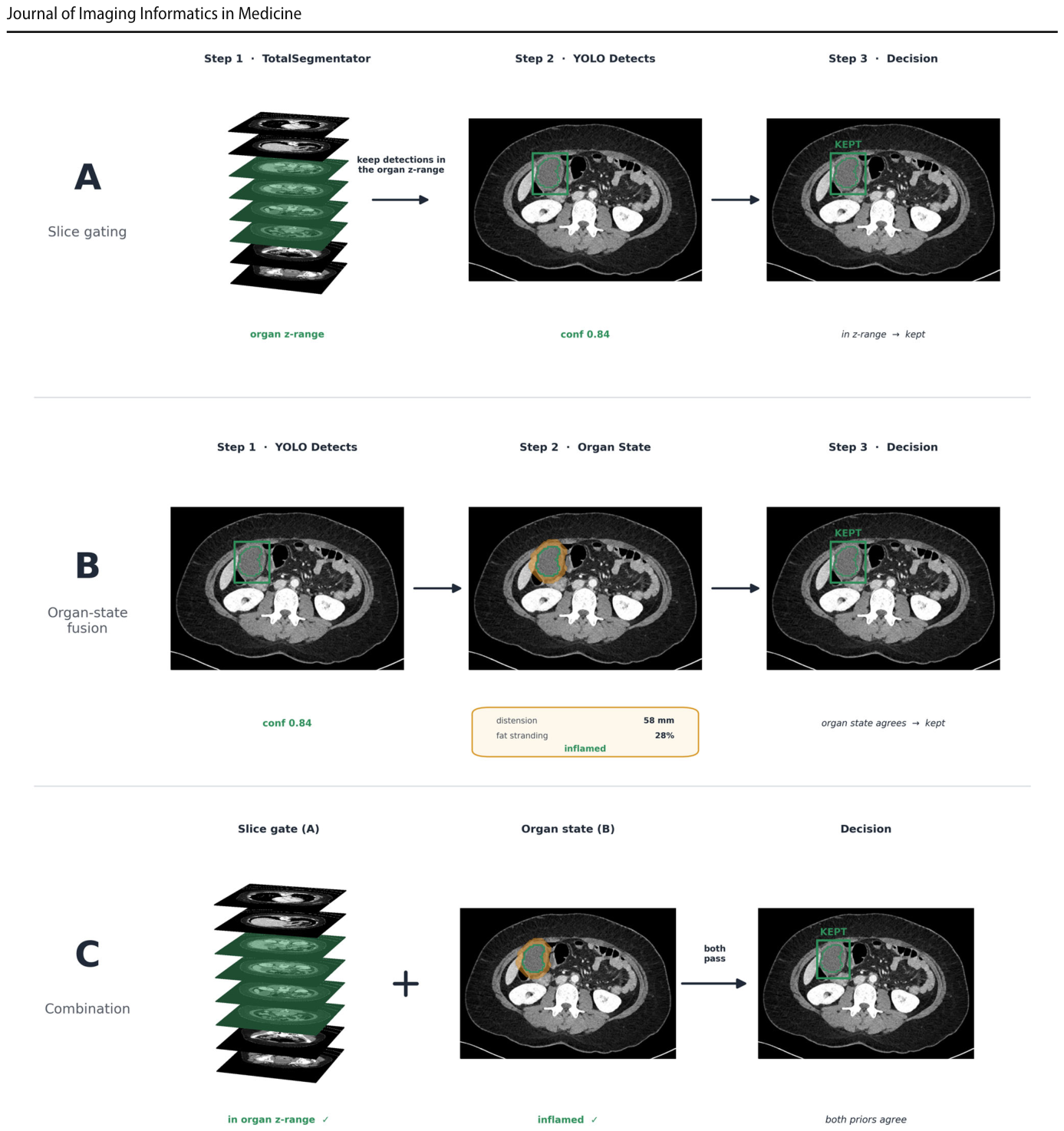
Figure 1. Fig. 1 The three anatomy strategies applied as priors over a frozen multi-window YOLOv11-Large detector using TotalSegmentator (TS), shownonarepresentativeexternalCT(StanfordMerlin;acutecholecys- titis exemplar, gallbladder outlined in green). Each row is a three-step pipeline. Arm A (slice gating): TS defines the organ’s axial z-range, and a detection is retained only if its slice lies within that range (equiv- alently, YOLO need run only on those slices). Arm B (organ-state fusion): for a detection, TS reads organ-state features (the displayed解説: 本図は、YOLOv11-Large検出器に適用される3つの解剖学的戦略(スライス選択、臓器状態融合、その組み合わせ)を、急性胆嚢炎のCT画像例で示しています。これらの戦略は、画像ピクセルを変更せず、検出後の処理として適用されます。
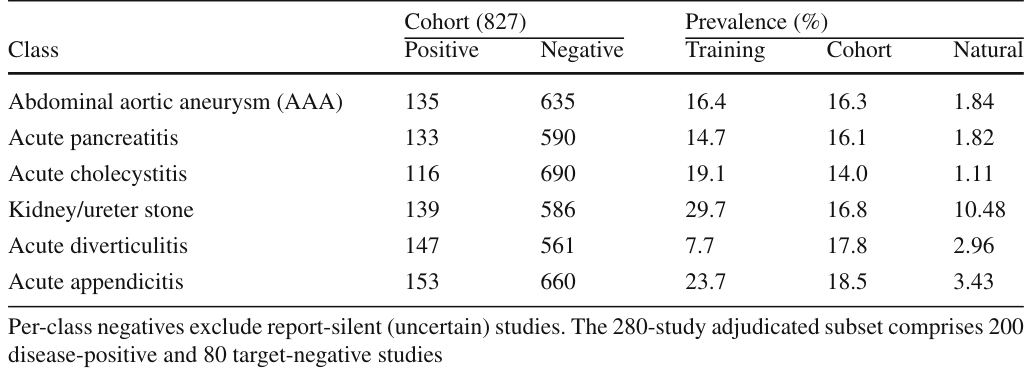
Table 1. Table 1 External cohort composition and disease prevalence. The 827-study class-capped cohort (734 disease-positive, capped per class, plus 93 target-negative) contains a 280-study radiologist-adjudicated subset. Prevalence is shown for the national training data, this evaluation cohort, and the natural Merlin population解説: 本表は、外部コホートの構成と疾患有病率をまとめています。827件の対象者で構成されるコホートと、その中の280件の専門家レビュー済みサブセットにおける、各クラスの陽性・陰性症例数、およびトレーニングデータ、本コホート、Merlinの自然有病率が示されています。
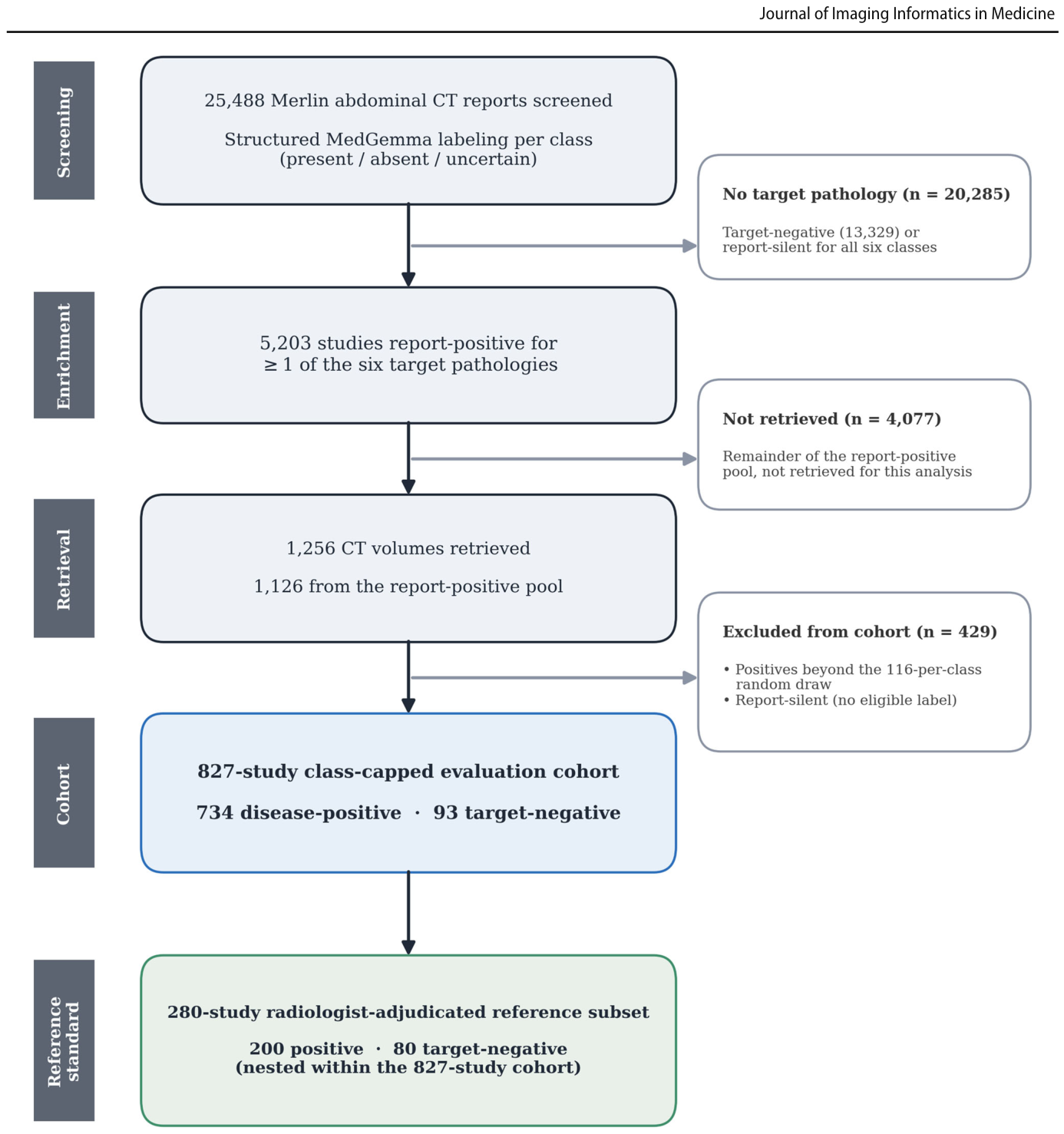
Figure 2. Fig. 2 Cohort assembly. Of 25,488 report-screened Merlin studies, 5203 were report-positive for at least one of the six target patholo- gies; from this enriched pool, 1256 volumes were retrieved (1126 report-positive). The class-capped 827-study cohort comprises 734解説: 本図は、研究におけるコホートの組み立てプロセスを示しています。25,488件のMerlin腹部CTレポートから、6種類の対象病変のうち少なくとも1つが報告された5,203件を抽出し、最終的に827件の評価コホートと、その中に含まれる280件の専門家レビュー済みサブセットを構築しました。
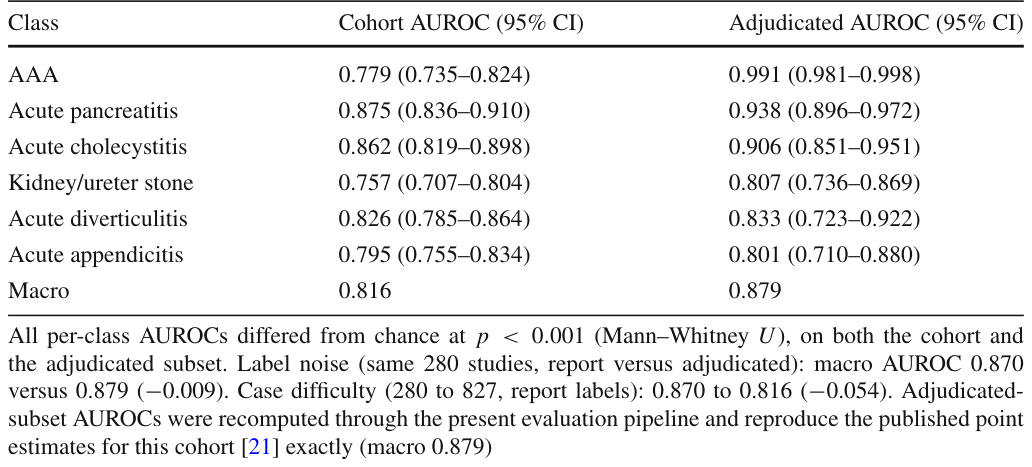
Table 2. Table 2 External discrimination of the frozen detector: per-class AUROC (study-level bootstrap 95% CI) on the 827-study cohort (report labels) and the 280-study adjudicated subset解説: 本表は、凍結された検出器の外部識別性能(AUROC)を、827件のコホート(レポートラベル)と280件の専門家レビュー済みサブセット(アノテーション済みラベル)について、病変ごとに95%信頼区間とともに示しています。全体のマクロAUROCも記載されており、検出器が外部データに対して高い識別性能を維持していることがわかります。
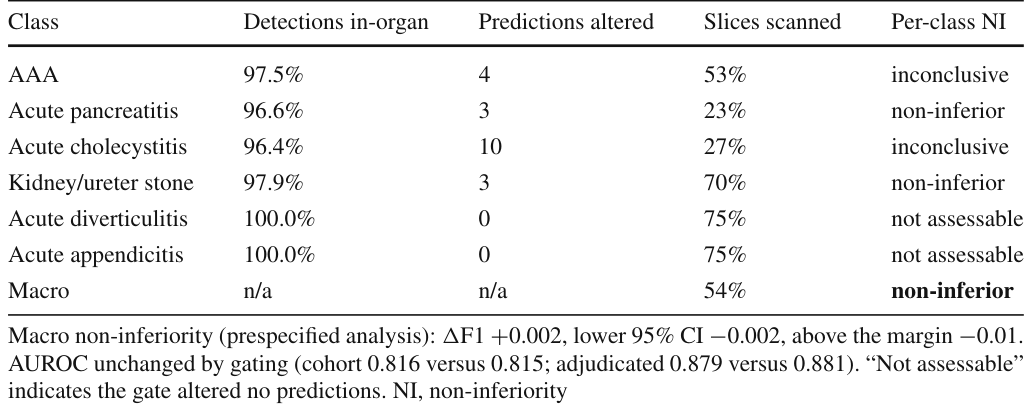
Table 5. Table 5 Anatomy-guided slice selection (Arm A, ±10-slice buffer): per-class fraction of confident detections already in-organ, number of predictions altered by the gate, fraction of axial slices scanned, and the per-class non-inferiority verdict解説: 本表は、解剖学的ガイド付きスライス選択(アームA)の効果を示しています。病変ごとの検出が既に臓器内にある割合、ゲートによって予測が変更された数、スキャンされた軸方向スライスの割合、および病変ごとの非劣性判定が示されています。ほとんどの検出が既に臓器内にあるため、ゲートによる変更は少ないことがわかります。
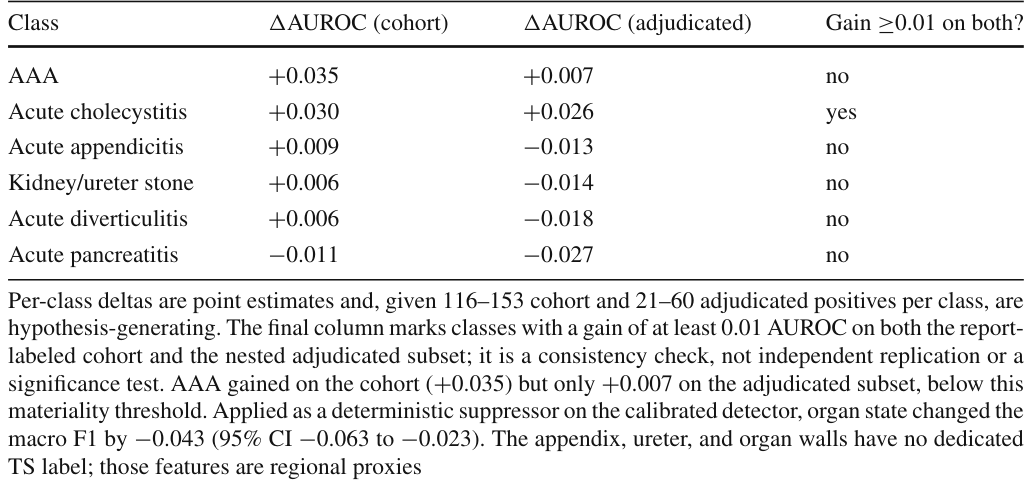
Table 6. Table 6 Organ-state integration (Arm B): per-class change in AUROC from a cross-validated fusion of detector confidence with organ state, on the 827-study cohort and on the 280-study adjudicated subset解説: 本表は、臓器状態統合(アームB)によるAUROCの病変ごとの変化を示しています。検出器の信頼度と臓器状態の交差検証された融合によって、827件のコホートと280件の専門家レビュー済みサブセットのAUROCがどのように変化したかが示されており、急性胆嚢炎のみで0.01以上の改善が見られました。
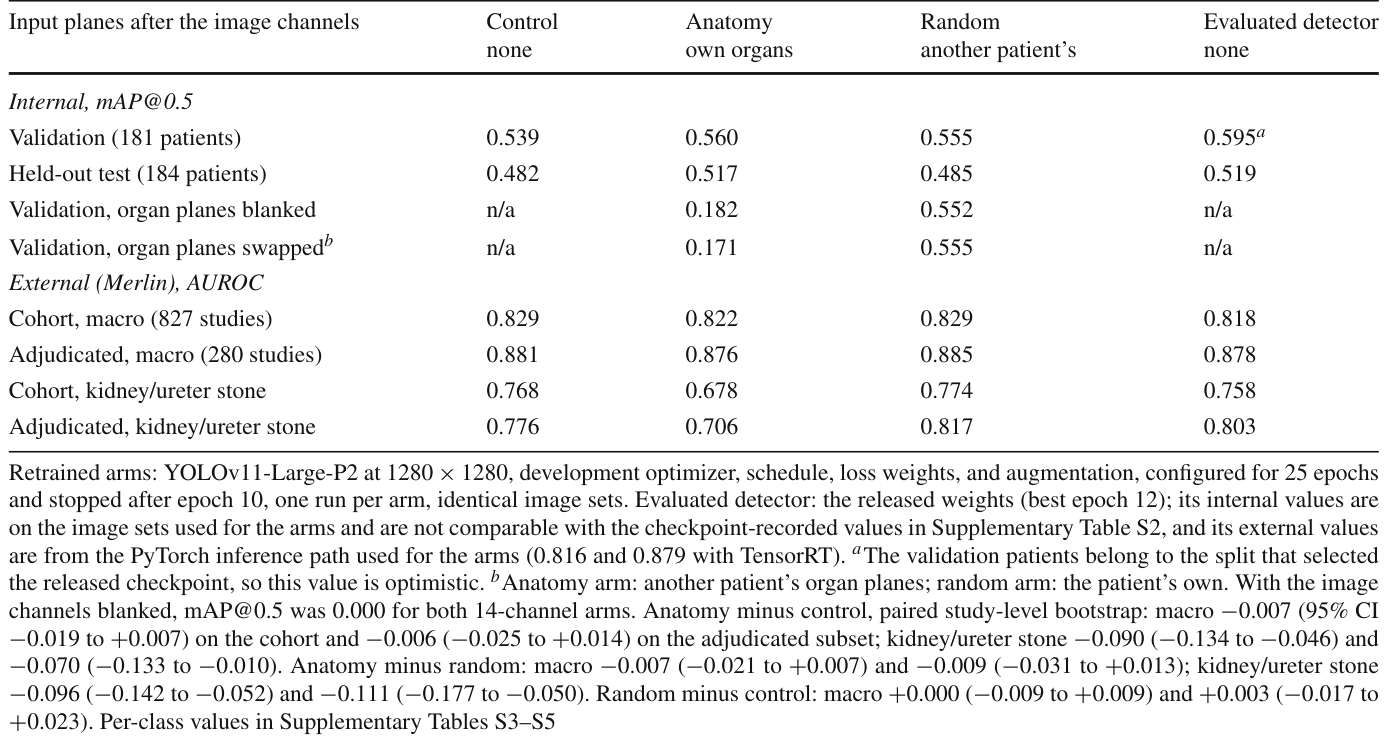
Table 7. Table 7 Training-time anatomy integration. Three detectors retrained from scratch under an identical 10-epoch budget, differing only in the input planes after the image channels: internal mAP@0.5, internal mAP@0.5 with the organ planes manipulated, and external AUROC on Merlin解説: 本表は、トレーニング時に解剖学的情報を統合した場合の検出器の性能を示しています。画像チャネルのみ、対象者自身の臓器マップ、別の対象者のマップをそれぞれ入力として再トレーニングされた3つのアームについて、内部mAP@0.5と外部(Merlin)AUROCが比較されています。臓器マップとの統合は内部性能を向上させるものの、外部性能、特に腎・尿管結石の検出性能を低下させたことが示されています。
これは、内部での性能向上が必ずしも外部データに転用されないことを示唆しています。
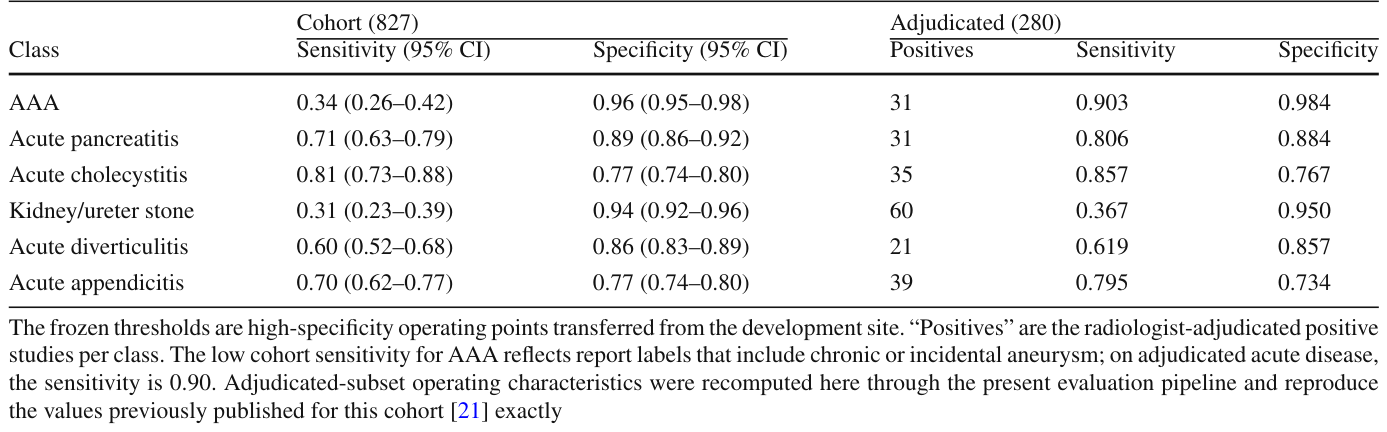
Table 4. Table 4 Detector operating characteristics at the frozen operating thresholds: per-class sensitivity and specificity on the 827-study cohort (report labels, with study-level bootstrap 95% CI) and on the 280-study adjudicated subset解説: 本表は、凍結された運用閾値における検出器の運用特性を、827件のコホートと280件の専門家レビュー済みサブセットについて、病変ごとの感度と特異度を95%信頼区間とともに示しています。運用閾値は、開発サイトから転用された高特異度ポイントです。
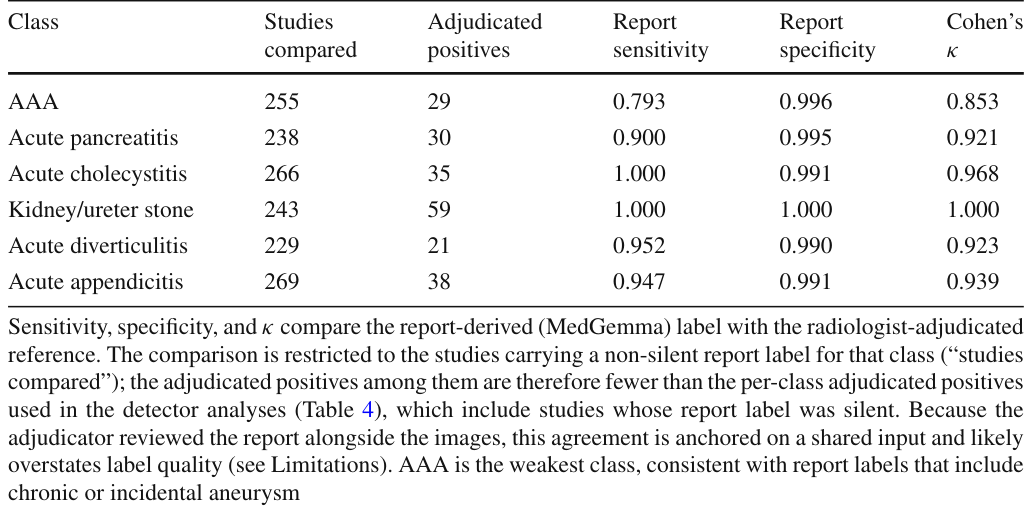
Table 3. Table 3 Agreement between report-derived and radiologist-adjudicated labels on the 280-study reference subset: per-class sensitivity, specificity, and Cohen’s κ of the language-model report labels measured against radiologist adjudication解説: 本表は、280件の専門家レビュー済みサブセットにおける、言語モデル由来のレポートラベルと専門家によるアノテーションとの合致度を示しています。病変ごとの感度、特異度、Cohenのκ係数が記載されており、両者の良好な一致が示されています。
コメントを残す