どうも、Beyond the Pixelです。医療画像診断において、放射線専門家が作成する自由記述のレポートは、非常に重要な臨床情報を含んでいます。しかし、これらのレポートは文章として記述されているため、そこから意味のある情報を自動で抽出し、その後の臨床分析や意思決定支援に活用することは困難でした。特に乳腺X線検査の分野では、施設ごとに記述スタイルが異なったり、標準化された用語が十分に浸透していなかったり、さらにスペイン語のような特定の言語におけるアノテーション(注釈付け)付きデータセットが不足していることが、情報抽出の課題を大きくしています。従来のルールベースシステムや古典的な自然言語処理(NLP)技術では、レポートの言語的多様性に対応しきれないことが多く、大規模言語モデル(LLM)の登場により、この状況に変化の兆しが見えています。本研究は、この課題に対し、タスクに特化したファインチューニング(追加学習)なしに、少数の例から汎化(応用)できるLLMの能力に着目し、Retrieval-Augmented Generation(RAG)フレームワークを提案しています。
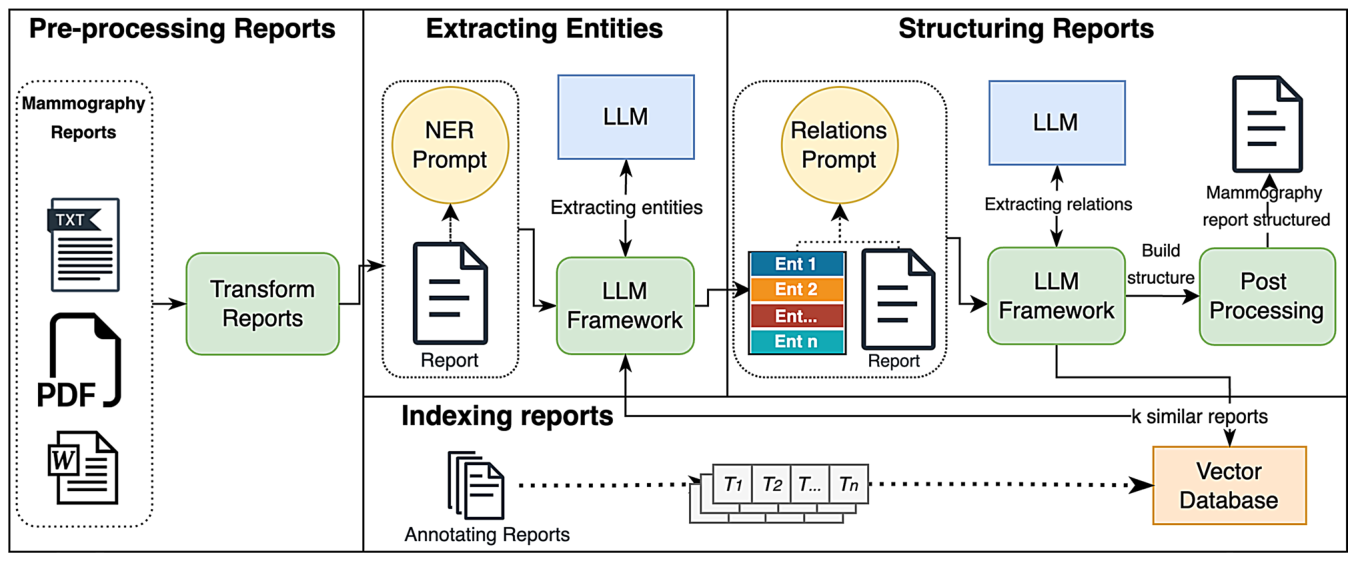
Figure 1. Fig. 1 Overview of the proposed LLM–RAG framework for structured information extraction from Spanish mammography reports. The pipeline con sists of four stages: (1) preprocessing and normalization of free-text reports; (2) entity and relation extraction using GPT-4o-mini and GPT-4.1-mini with few-shot prompting; (3) structuring of extracted information into standardized BI-RADS-based report schemas; and (4) retrieval-augmented indexing of annotated reports in a vector database to enable contextual grounding for future inference tasks解説: この図は、スペイン語の乳腺X線レポートから構造化された臨床情報を抽出するために提案された、LLMとRAGを組み合わせたフレームワークの全体像を示しています。パイプラインは、レポートの前処理、エンティティ抽出、レポート構造化の4つの段階で構成されており、アノテーション付きレポートから構築されたベクトルデータベースが文脈的根拠を提供します。
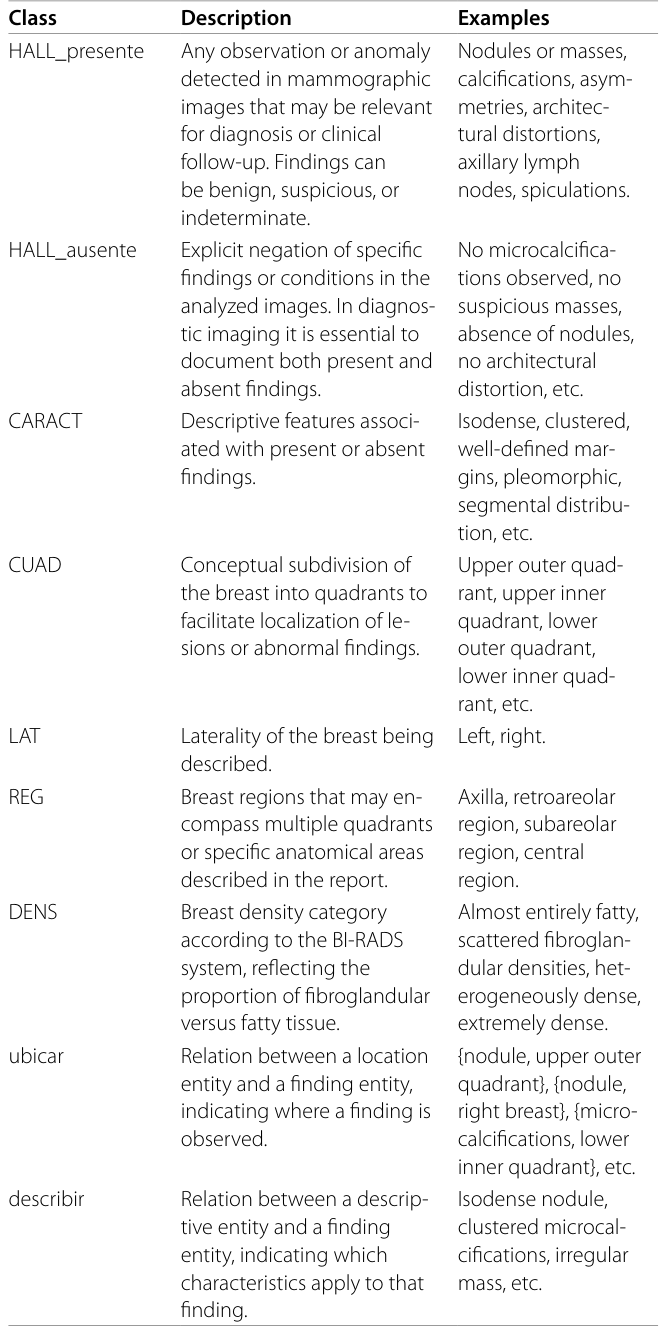
Table 2. Table 2 Descriptions and examples of the entity and relation classes annotated in mammography reports for the NER and RE tasks Class Description Examples HALL_presente Any observation or anomaly detected in mammographic images that may be relevant for diagnosis or clinical follow-up. Findings can be benign, suspicious, or indeterminate.解説: この表は、固有表現認識(NER)と関係抽出(RE)タスクのために乳腺X線レポートでアノテーションされたエンティティと関係クラスの説明および例を示しています。
この表は、本研究で定義されたエンティティクラス(HALL_presente, HALL_ausente, CARACT, CUAD, LAT, REG, DENS)とその説明、および具体的な例を示しています。また、2つの関係クラス(ubicar, describir)についても説明されており、これらの情報がどのように構造化されるかが分かります。
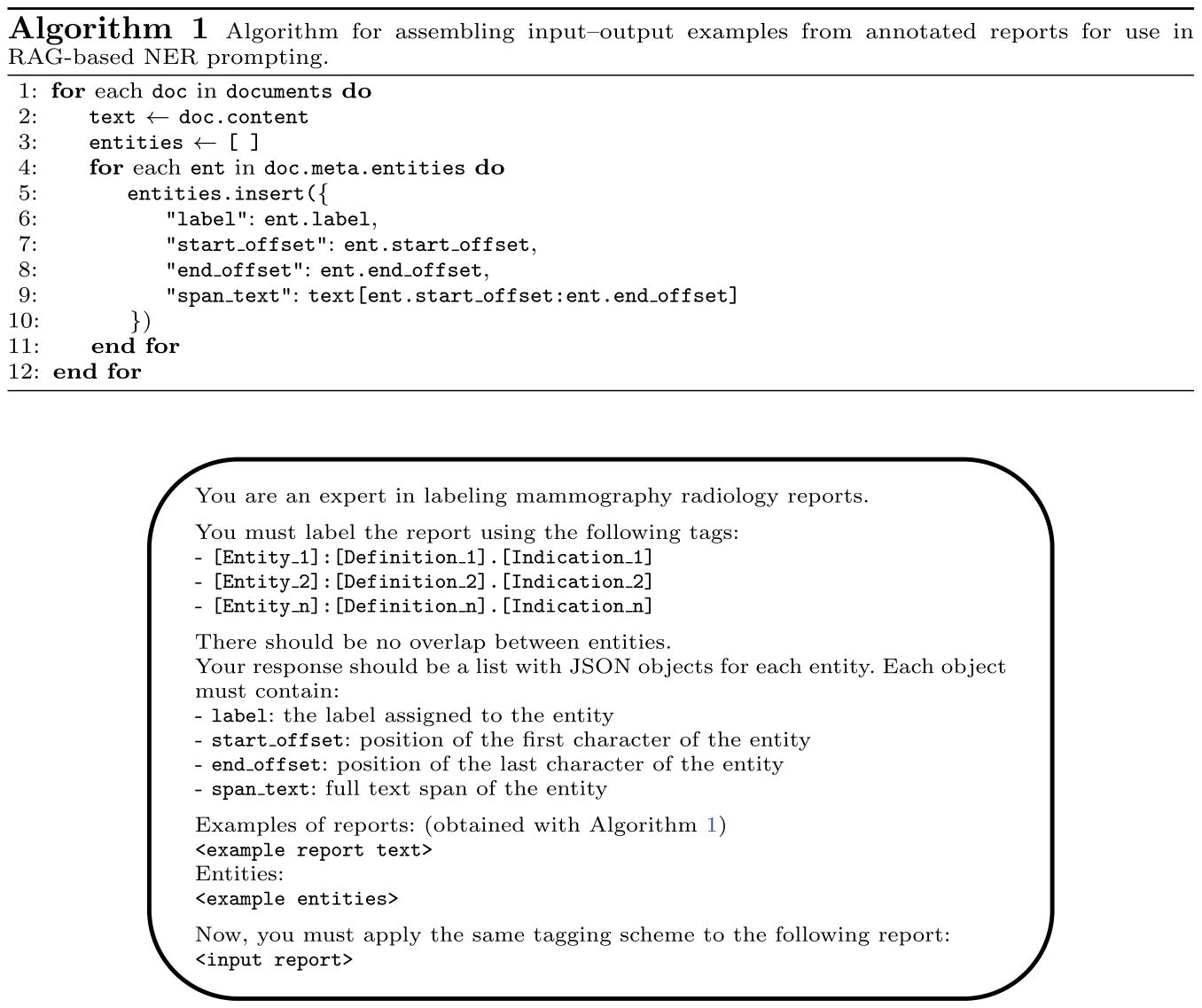
Figure 2. Fig. 2 Instruction prompt used for structured labeling of mammography radiology reports. The prompt guides the model to extract non-overlapping entities and generate standardized JSON annotations with label, offsets, and span text. The content shown here is translated into English解説: この図は、RAGベースの固有表現認識(NER)プロンプトで入出力例を生成するためのアルゴリズムと、乳腺X線放射線レポートの構造化されたラベリングに使用される命令プロンプトの例を示しています。プロンプトは、重複しないエンティティを抽出し、ラベル、オフセット、スパンテキストを含む標準化されたJSONアノテーションを生成するようにモデルをガイドします。
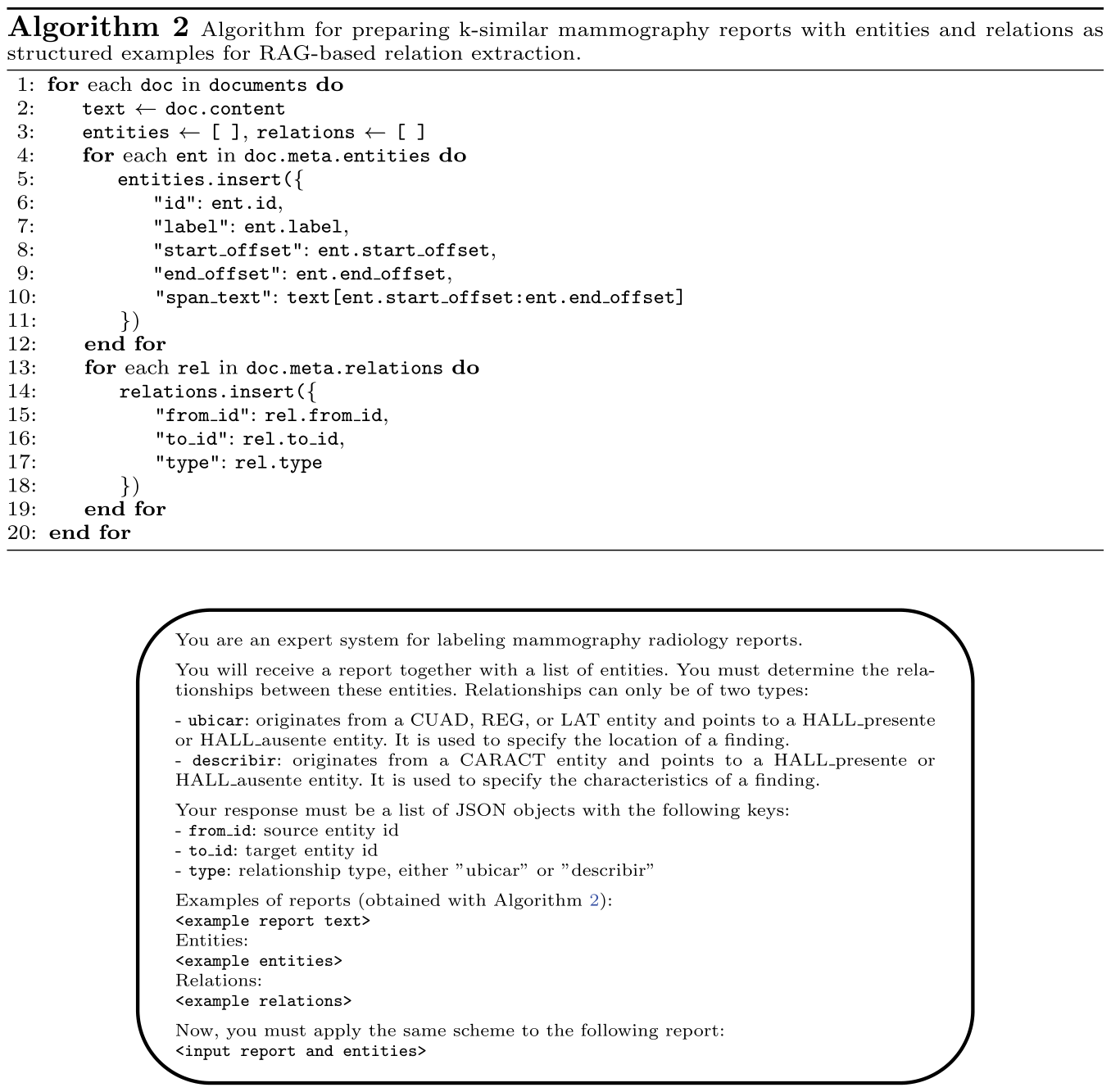
Figure 3. Fig. 3 Instruction prompt used for extraction of relationships between entities in mammography reports. It defines two relation types, ubicar (locate) and describir (describe), linking anatomical or descriptive entities to findings for structured clinical interpretation. The content shown here is trans lated into English解説: この図は、乳腺X線レポートにおけるエンティティ間の関係を抽出するために使用される命令プロンプトの例と、RAGのためにk個の類似したレポートを準備するアルゴリズムを示しています。ubicar(位置特定)とdescribir(記述)という2つの関係タイプを定義し、解剖学的または記述的なエンティティを所見にリンクさせて構造化された臨床解釈を可能にします。
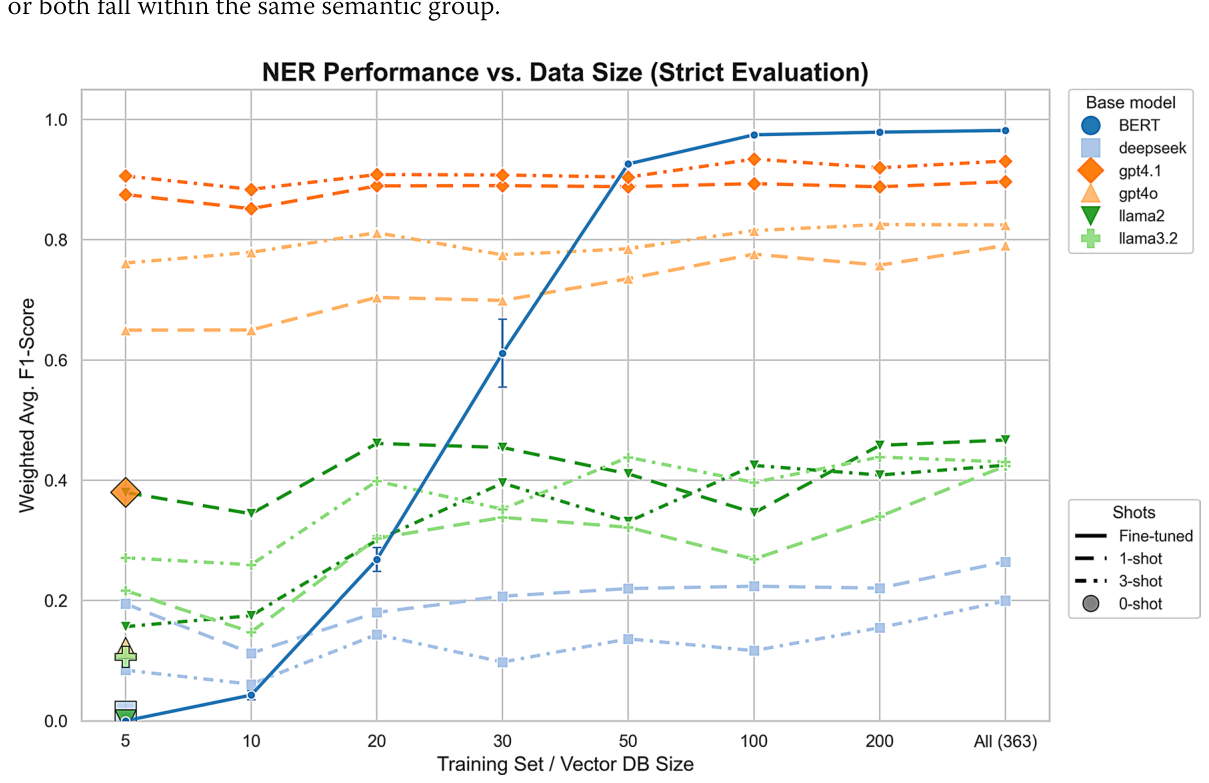
Figure 4. Fig. 4 Weighted Finline-eq-IEq16-scores obtained under strict NER evaluation across all dataset sizes for the fine-tuned BETO baseline and the tested LLM configura tions. Note: In the plot legends, labels ‘gpt4.1’ and ‘gpt4o’ refer to the ‘GPT-4.1-mini’ and ‘GPT-4o-mini’ models described in the text解説: この図は、厳格な固有表現認識(NER)評価において、さまざまなデータサイズで得られたファインチューニングされたBETOベースラインとテスト済みLLM構成の加重平均F1スコアを示しています。グラフの凡例で「gpt4.1」は「GPT-4.1-mini」モデルを、「gpt4o」は「GPT-4o-mini」モデルを指します。
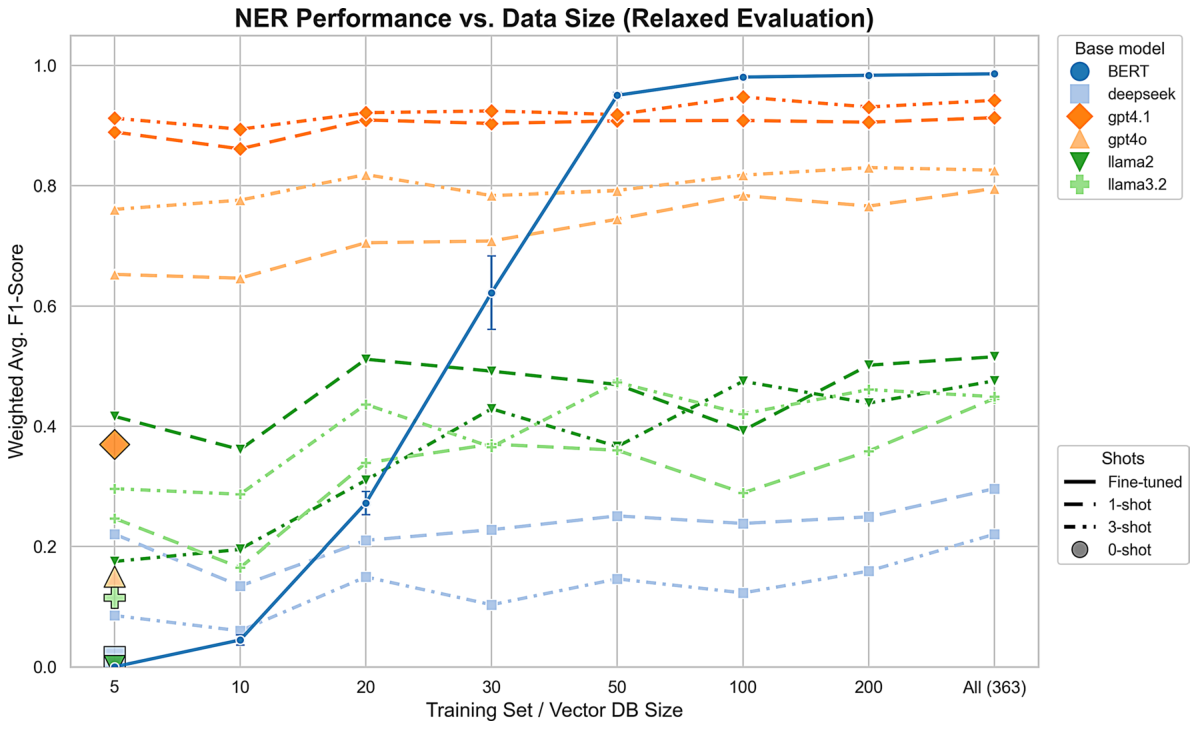
Figure 5. Fig. 5 Weighted Finline-eq-IEq17-scores obtained under relaxed NER evaluation. Relaxed matching increased scores for all models while preserving the relative rank ing. Note: In the plot legends, labels ‘gpt4.1’ and ‘gpt4o’ refer to the ‘GPT-4.1-mini’ and ‘GPT-4o-mini’ models described in the text解説: この図は、緩和された固有表現認識(NER)評価で得られた加重平均F1スコアを示しています。緩和されたマッチングにより、すべてのモデルでスコアが向上しましたが、相対的な順位は維持されています。グラフの凡例で「gpt4.1」は「GPT-4.1-mini」モデルを、「gpt4o」は「GPT-4o-mini」モデルを指します。
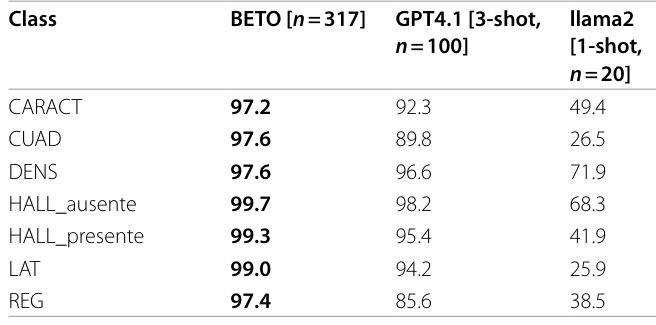
Table 3. Table 3 Per-class Finline-eq-IEq25 (%) for NER (strict): best configuration for BETO, GPT-4.1-mini and LLaMA 2 Class BETO [n = 317] GPT4.1 [3-shot, n = 100]解説: この表は、厳格評価における固有表現認識(NER)のクラスごとのF1スコア(%)を示しており、BETO、GPT-4.1-mini、およびLLaMA 2の最適な構成の結果が記載されています。
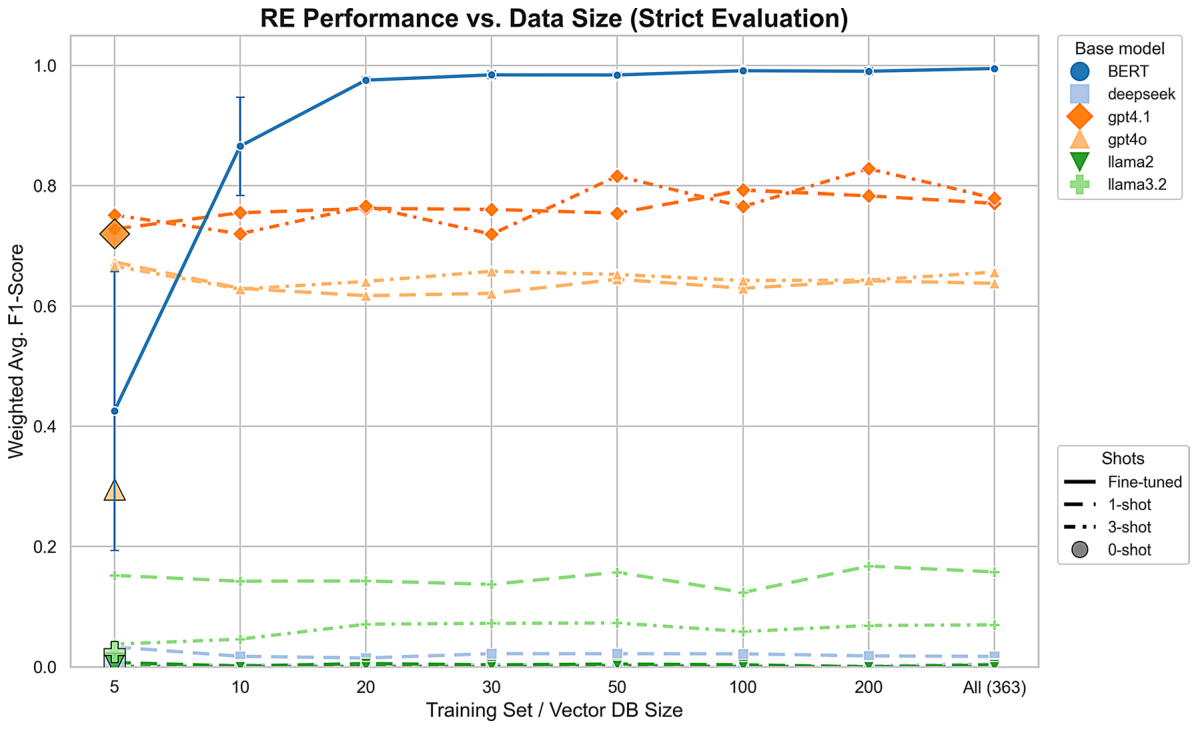
Figure 6. Fig. 6 Weighted Finline-eq-IEq30-scores obtained under strict RE evaluation. The fine-tuned BETO baseline represents the upper bound, with GPT-based models show ing lower but stable performance in the few-shot regime. Note: In the plot legends, labels ‘gpt4.1’ and ‘gpt4o’ refer to the ‘GPT-4.1-mini’ and ‘GPT-4o-mini’ models described in the text解説: この図は、厳格な関係抽出(RE)評価で得られた加重平均F1スコアを示しています。ファインチューニングされたBETOベースラインが性能の上限を示し、GPTベースモデルはfew-shot設定で低いものの安定した性能を示しています。グラフの凡例で「gpt4.1」は「GPT-4.1-mini」モデルを、「gpt4o」は「GPT-4o-mini」モデルを指します。
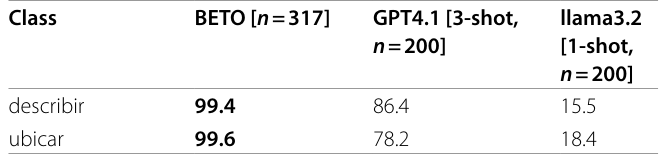
Table 4. Table 4 Per-class Finline-eq-IEq35 (%) for RE: best configuration for BETO, GPT- 4.1-mini and LLaMA 3.2 Class BETO [n = 317] GPT4.1 [3-shot, n = 200]解説: この表は、関係抽出(RE)のクラスごとのF1スコア(%)を示しており、BETO、GPT-4.1-mini、およびLLaMA 3.2の最適な構成の結果が記載されています。
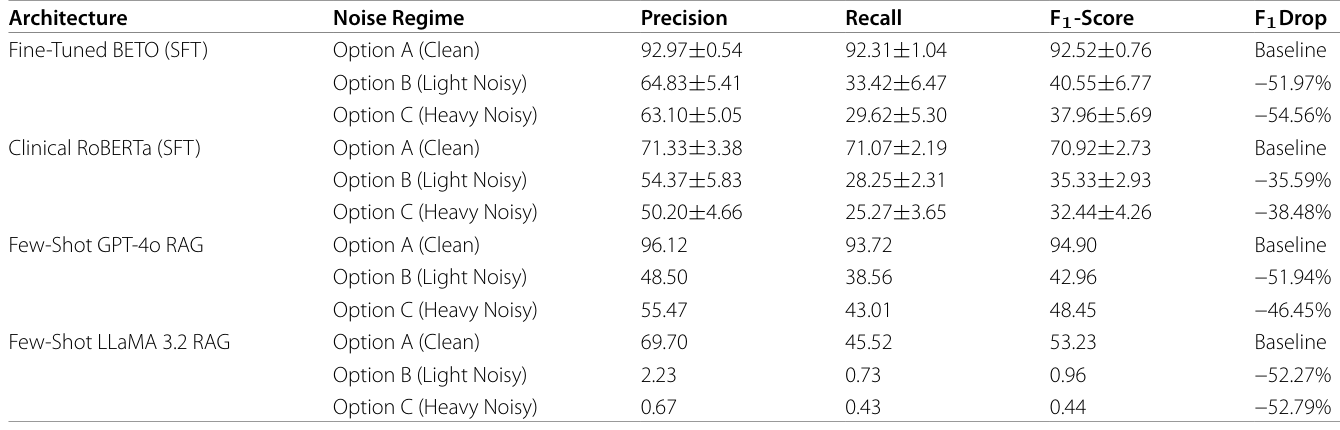
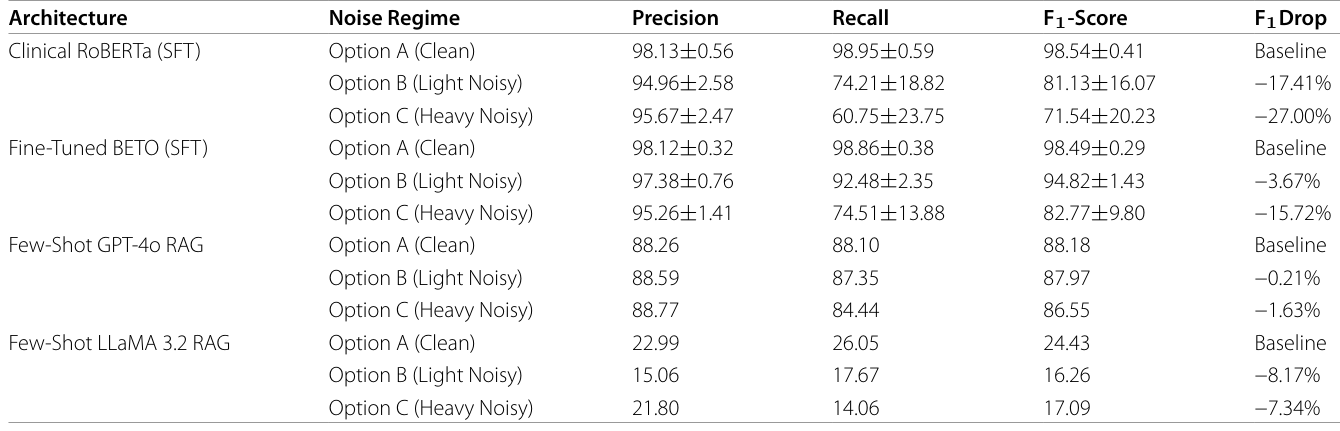
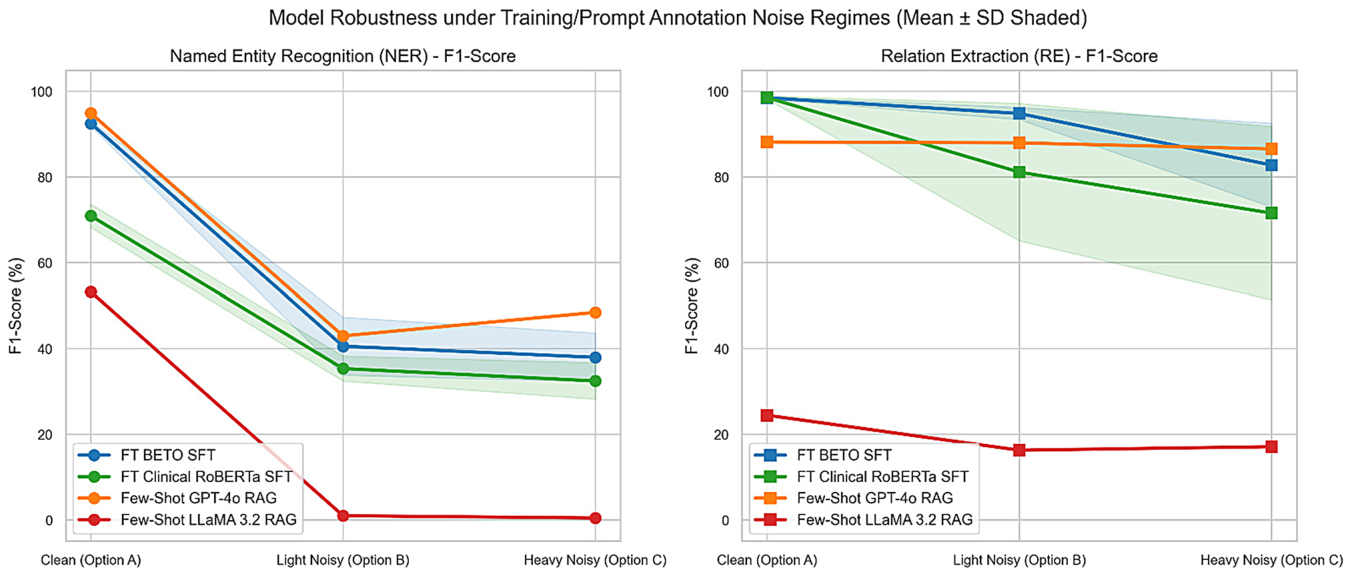
Figure 7. Fig. 7 Robustness analysis under increasing annotation noise regimes applied to supervised training data and RAG retrieval examples. Option a cor responds to clean annotations, Option B introduces light annotation perturbations, and Option C simulates heavily noisy annotations. The left panel shows NER Finline-eq-IEq79-scores and the right panel shows RE Finline-eq-IEq80-scores. Shaded regions indicate standard deviation across perturbation runs. GPT-4o-mini with RAG preserved comparatively stable performance under noisy retrieval conditions, while supervised models exhibited larger degradation, particularly in NER under heavy annotation corruption
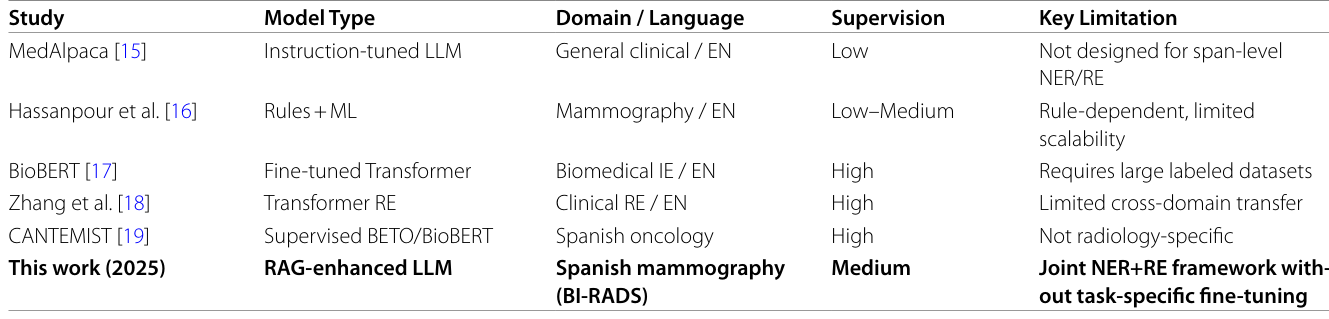
Table 1. Table 1 State-of-the-art approaches for clinical information extraction. Comparison focuses on supervision level, clinical scope, and support for joint NER+RE without fine-tuning Study Model Type Domain / Language Supervision Key Limitation MedAlpaca [15] Instruction-tuned LLM General clinical / EN Low Not designed for span-level NER/RE Hassanpour et al. [16] Rules + ML Mammography / EN Low–Medium Rule-dependent, limited scalability BioBERT [17] Fine-tuned Transformer Biomedical IE / EN High Requires large labeled datasets Zhang et al. [18] Transformer RE Clinical RE / EN High Limited cross-domain transfer CANTEMIST [19] Supervised BETO/BioBERT Spanish oncology High Not radiology-specific This work (2025) RAG-enhanced LLM Spanish mammography (BI-RADS)解説: この表は、臨床情報抽出における最先端のアプローチの比較概要をまとめたものです。教師レベル、臨床ドメイン、およびファインチューニングなしでの固有表現認識(NER)と関係抽出(RE)の共同サポートに焦点を当てています。
Table 7
Table 7. Table 7 Average cost, token usage, and latency for NER: grouped by model, number of shots, and normalized per report. Averages for 1/3-shot configurations are computed across different database sizes Model Shots Cost ($) Input Tok Output Tok Latency (s) GPT-4.1-mini 0 $0.000774 631 326 8.74 GPT-4.1-mini 1 $0.001217inline-eq-IEq810.000013 1350inline-eq-IEq8216 423inline-eq-IEq835 11.45inline-eq-IEq840.92 GPT-4.1-mini 3 $0.001788inline-eq-IEq850.000037 2809inline-eq-IEq8687 415inline-eq-IEq87 10.86inline-eq-IEq881.14 GPT-4o-mini 0 $0.000264 575 297 6.42 GPT-4o-mini 1 $0.000405inline-eq-IEq890.000007 1268inline-eq-IEq9014 359inline-eq-IEq918 8.45inline-eq-IEq921.49 GPT-4o-mini 3 $0.000624inline-eq-IEq930.000016 2672inline-eq-IEq9482 372inline-eq-IEq957 7.54inline-eq-IEq960.56
Table 8
Table 8. Table 8 Average cost, token usage, and latency for RE: grouped by model, number of shots, and normalized per report. Averages for 1/3-shot configurations are computed across different database sizes Model Shots Cost ($) Input Tok Output Tok Latency (s) GPT-4.1-mini 0 $0.000757 1046 212 7.43 GPT-4.1-mini 1 $0.001235inline-eq-IEq970.000014 2283inline-eq-IEq9830 201inline-eq-IEq993 6.00inline-eq-IEq100 .69 GPT-4.1-mini 3 $0.002239inline-eq-IEq1010.000073 4811inline-eq-IEq102194 197inline-eq-IEq1036 5.75inline-eq-IEq1041.48 GPT-4o-mini 0 $0.000254 986 177 5.36 GPT-4o-mini 1 $0.000450inline-eq-IEq1050.000005 2201inline-eq-IEq10638 200inline-eq-IEq1074 8.97inline-eq-IEq1085.29 GPT-4o-mini 3 $0.000810inline-eq-IEq1090.000027 4630inline-eq-IEq110168 192inline-eq-IEq1114 6.42inline-eq-IEq1120.42
Table 11
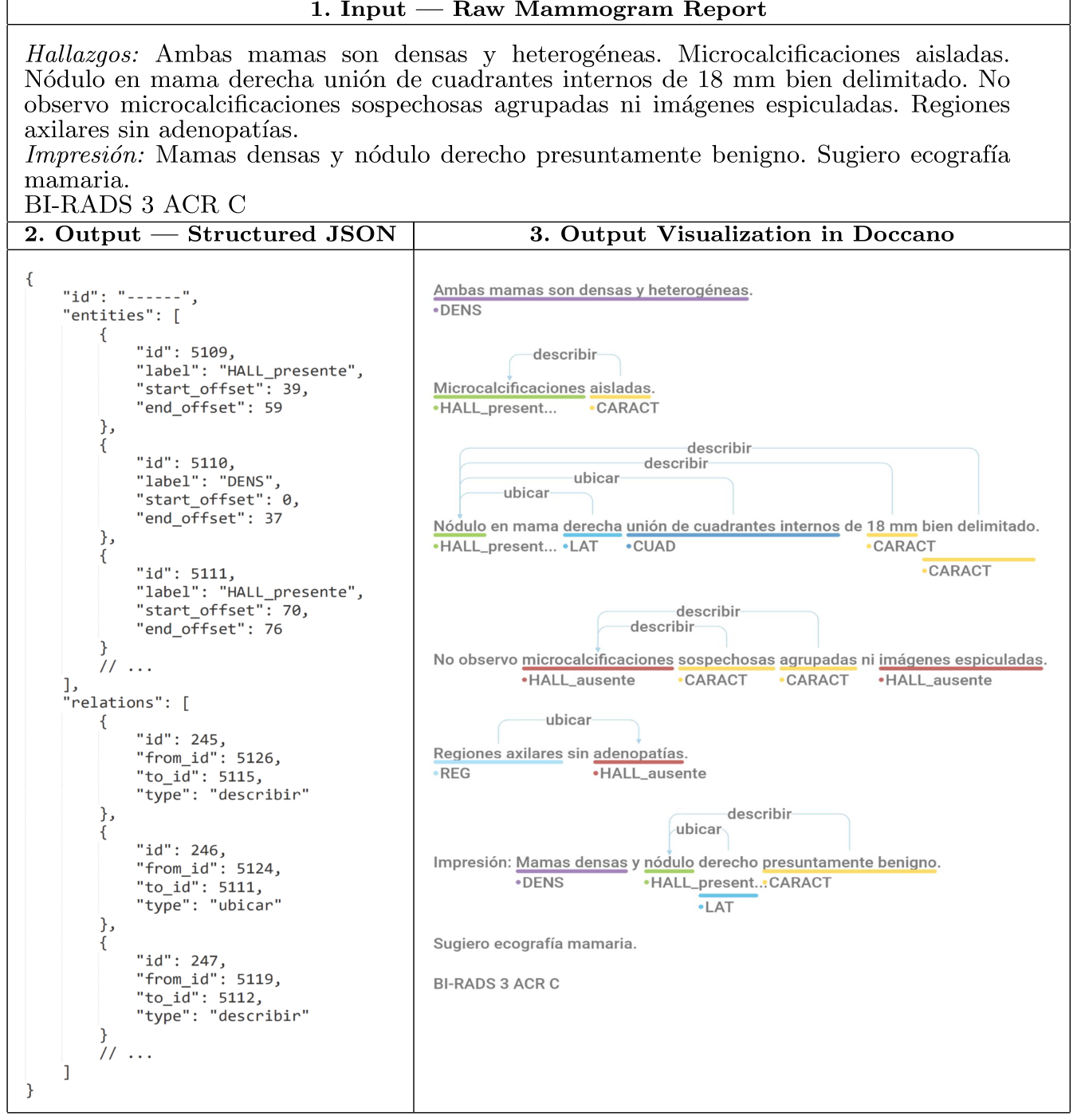
Table 11. Table 11 Example of the complete inference pipeline applied to a mammography report using the proposed framework. Section 1 shows the raw report, Section 2 the structured JSON output, and Section 3 the corresponding visualization in doccano
Table 12
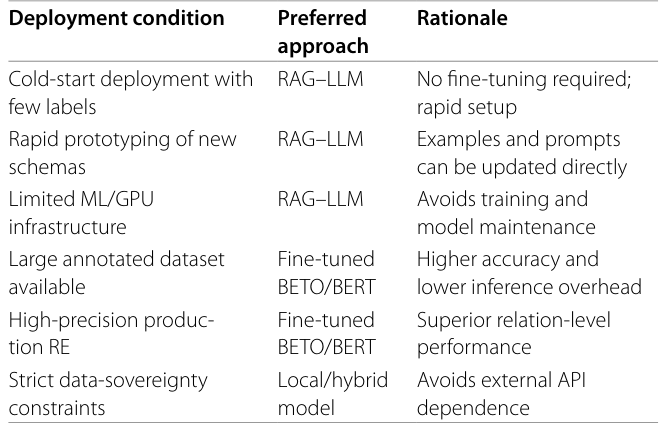
Table 12. Table 12 Decision guideline for selecting between RAG– LLM and supervised BETO-based approaches according to deployment conditions Deployment condition Preferred approach


コメントを残す