どうも、Beyond the Pixelです。近年、機械学習(ML)の目覚ましい進歩と大規模データセットの利用可能性拡大により、さまざまな分野で強力なモデルが開発されています。しかし、これらのアプローチのほとんどは、大量の完全にラベル付けされたデータを必要とする教師あり学習(SL)に大きく依存しています。この依存性は、特にラベル付きデータが希少で、費用がかかり、取得に時間がかかる実際の医療画像診断アプリケーションにおいて、重大な課題となっています。このような状況を打開するために、半教師あり学習(SSL)が有望な代替手段として浮上しています。SSLは、ラベル付きデータとラベルなしデータの両方を活用することで、特にデータが限られたシナリオにおいてモデル性能を大幅に向上させることができます。しかし、SSLにおける「擬似ラベル」の生成には、不正確な擬似ラベルが訓練中にエラーを伝播させ、最終的にモデル性能を低下させる可能性があるという課題が伴います。この課題に対処するため、最近の研究では不確実性認識技術の統合が注目されています。その一つであるコンフォーマル予測(CP)は、予測セットの信頼性を統計的に保証するフレームワークであり、擬似ラベルの信頼性を制御するメカニズムとして機能します。
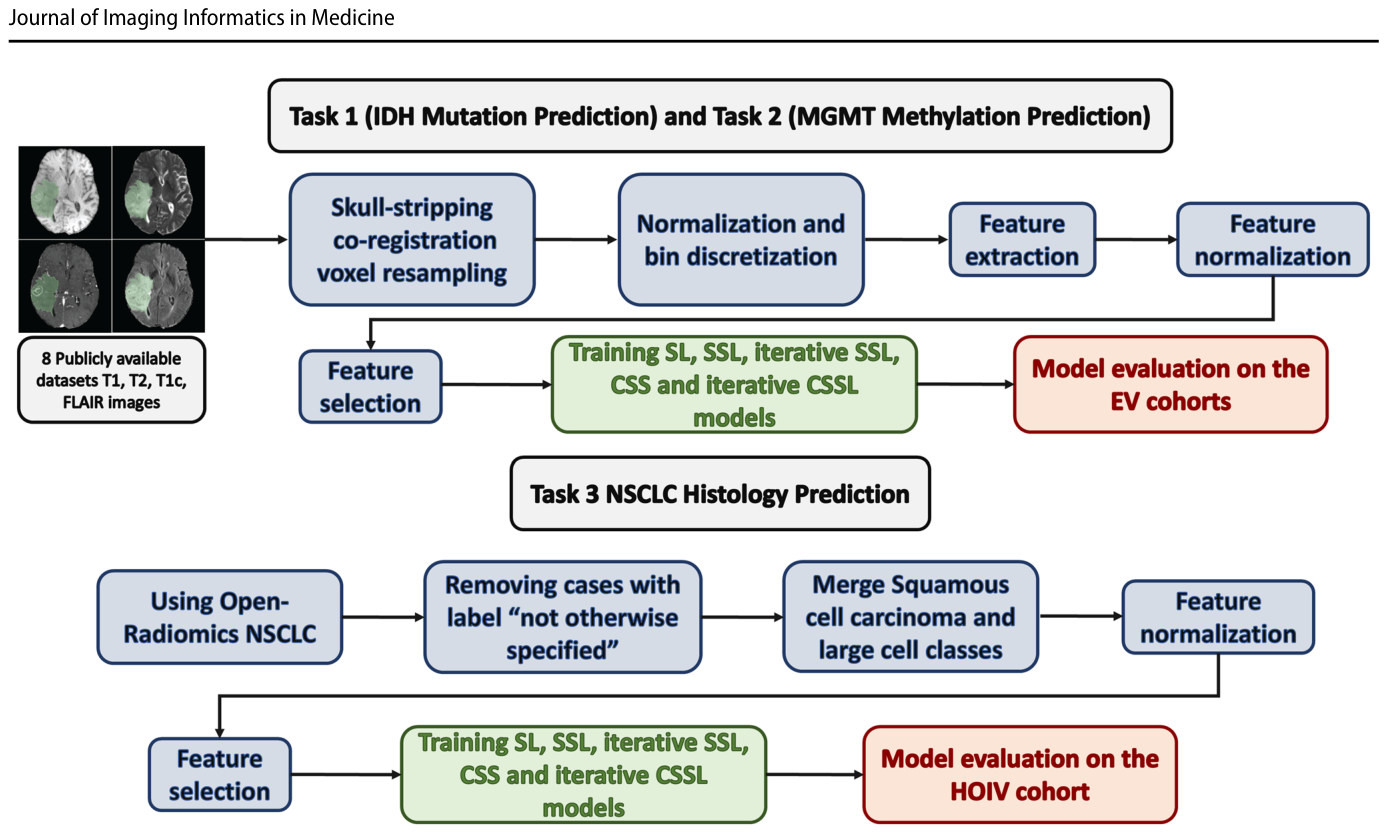
Figure 1. Fig. 1 Overview of the analytical workflow for tasks 1–3. For task 1 (IDH mutation prediction) and task 2 (MGMT methylation pre- diction), preoperative MRI scans (T1-weighted, contrast-enhanced T1-weighted, T2-weighted, and FLAIR sequences) and correspond- ing segmentation masks from eight publicly available glioma datasets were preprocessed (skull-stripping, co-registration, and resampling to isotropic voxel spacing), followed by intensity normalization and bin discretization. Radiomics features were then extracted and normal- ized, and the cohort was split into training, unlabeled, and external validation (EV) sets before feature selection. For task 3 (NSCLC his- tology prediction), pre-extracted radiomics features from the open-解説: この図は、IDH変異予測とMGMTメチル化予測、およびNSCLC組織学的予測における分析ワークフローの概要を示しています。MRIおよびCTスキャンからラジオミクス特徴量を抽出し、正規化と特徴選択を経て、SL、SSL、反復SSL、CSSL、反復CSSLのモデルを訓練し、性能を比較しました。
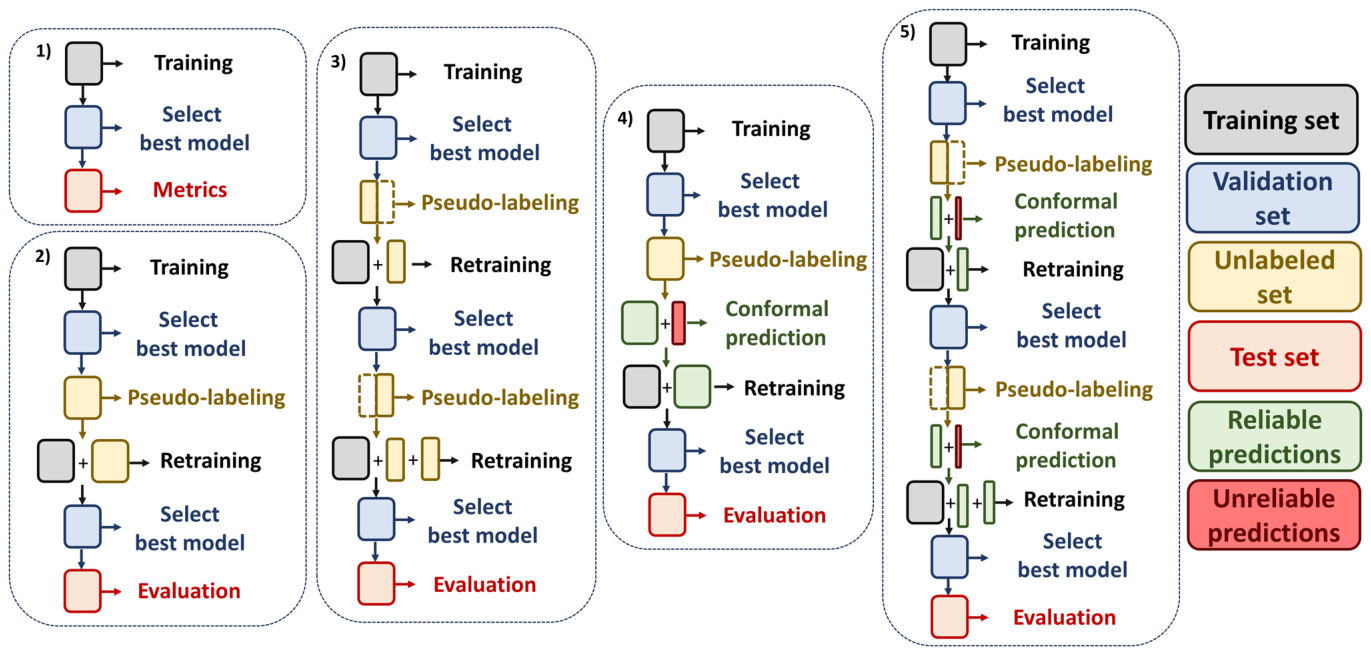
Figure 2. Fig. 2 Overview of the proposed SL and SSL frameworks. (1) SL: the model is trained using only labeled data and evaluated on the test set. (2) SSL: pseudo-labels are generated for unlabeled data and incorporated into the training set for model retraining. (3) Iterative SSL: the unlabeled dataset is divided into k folds (k = 2 in this study), and pseudo-labels are sequentially generated and added to the train- ing set in a stepwise manner. (4) CSSL: CP is used to estimate predic-解説: この図は、提案されたSLおよびSSLフレームワークの概要を示しています。(1)SL: ラベル付きデータのみでモデルを訓練し、テストセットで評価します。(2)SSL: ラベルなしデータに対して擬似ラベルを生成し、訓練セットに組み込んでモデルを再訓練します。(3)反復SSL: ラベルなしデータセットをk個のフォールドに分割し、擬似ラベルを段階的に生成して訓練セットに追加します。(4)CSSL: CPを使用して予測不確実性を推定し、信頼度の高い(確実な)擬似ラベル付きサンプルのみを訓練セットに組み込みます。(5)反復CSSL: ラベルなしデータをk個のフォールドで処理し、各イテレーションでCPを適用して信頼度の高い擬似ラベルを選択し、訓練セットに順次追加します。すべてのフレームワークにおいて、モデル選択は内部検証性能に基づいて行われ、最終評価はテストセットで実施されます。
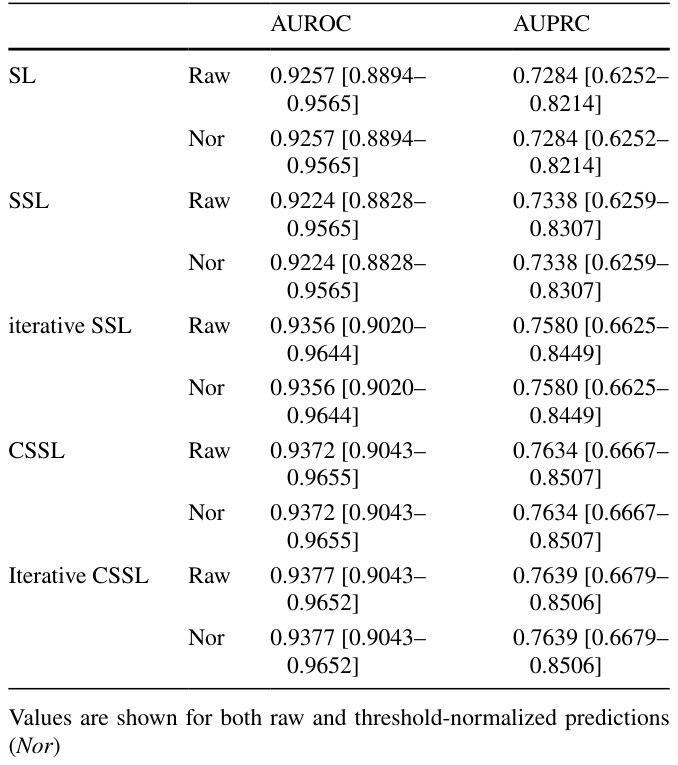
Table 1. Table 1 AUROC and AUPRC (point estimates with 95% bootstrap confidence intervals) for the five modeling strategies (SL, SSL, itera- tive SSL, CSSL, iterative CSSL), evaluated on the external test set for IDH mutation prediction解説: この表は、IDH変異予測の外部テストセットで評価された、5つのモデリング戦略(SL、SSL、反復SSL、CSSL、反復CSSL)のAUROCおよびAUPRC(95%ブートストラップ信頼区間付きの点推定値)を示しています。
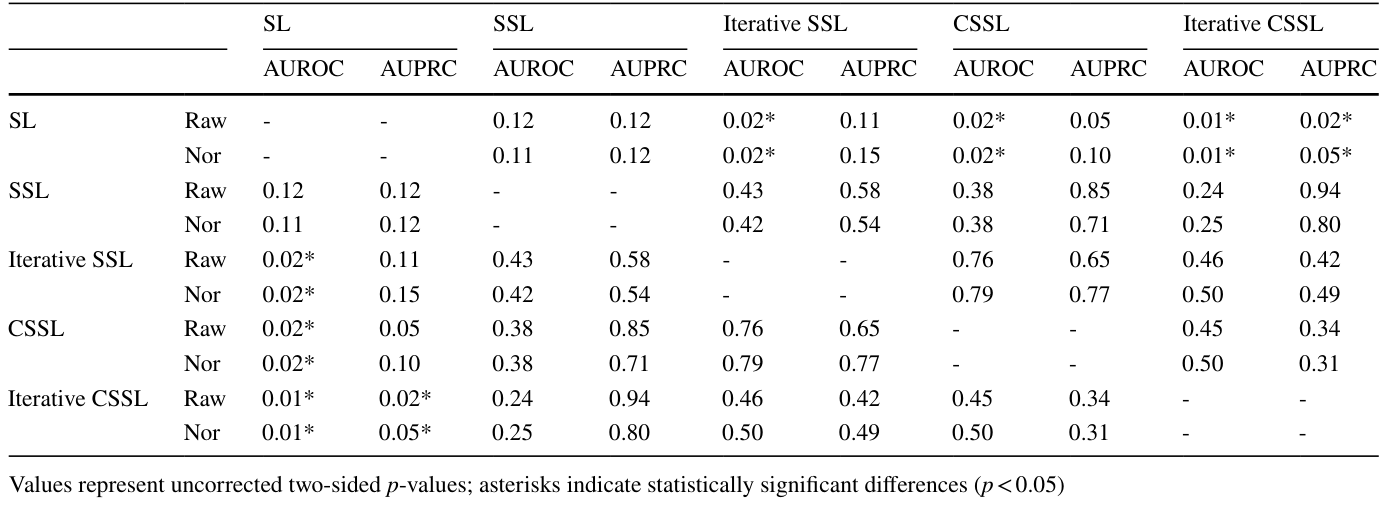
Table 2. Table 2 Pairwise statistical comparisons of AUROC (DeLong test) and AUPRC (paired bootstrap test) between modeling strategies for IDH mutation prediction, shown separately for raw and threshold-normalized predictions (Nor)解説: この表は、IDH変異予測におけるモデリング戦略間のAUROC(DeLong検定)およびAUPRC(ペアブートストラップ検定)のペアワイズ統計比較を、生データと閾値正規化された予測についてそれぞれ示しています。値は未補正の両側p値であり、アスタリスクは統計的に有意な差(p < 0.05)を示します。
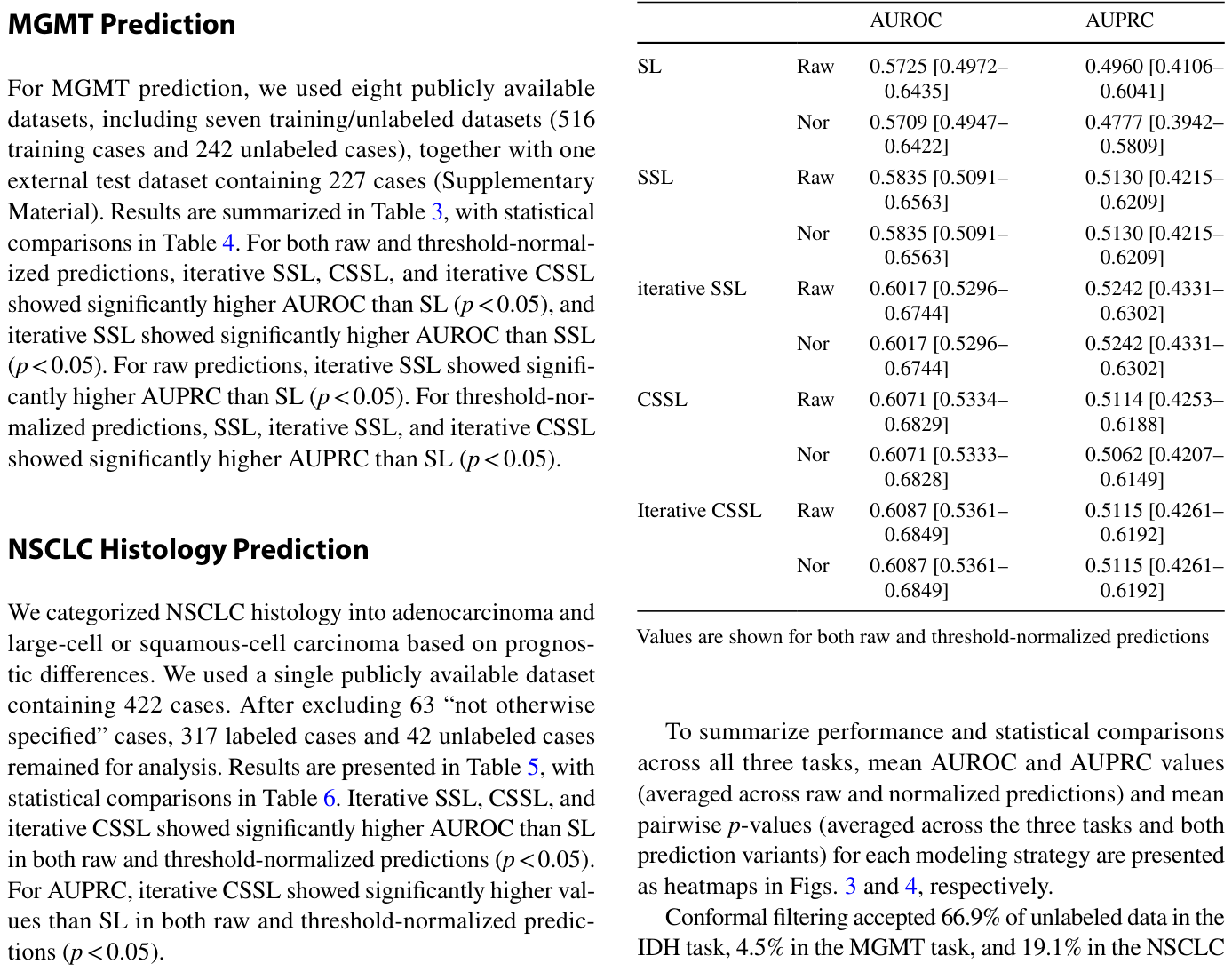
Table 3. Table 3 AUROC and AUPRC (point estimates with 95% bootstrap confidence intervals) for the five modeling strategies (SL, SSL, itera- tive SSL, CSSL, iterative CSSL), evaluated on the external test set for MGMT methylation prediction解説: この表は、MGMTメチル化予測の外部テストセットで評価された、5つのモデリング戦略(SL、SSL、反復SSL、CSSL、反復CSSL)のAUROCおよびAUPRC(95%ブートストラップ信頼区間付きの点推定値)を示しています。
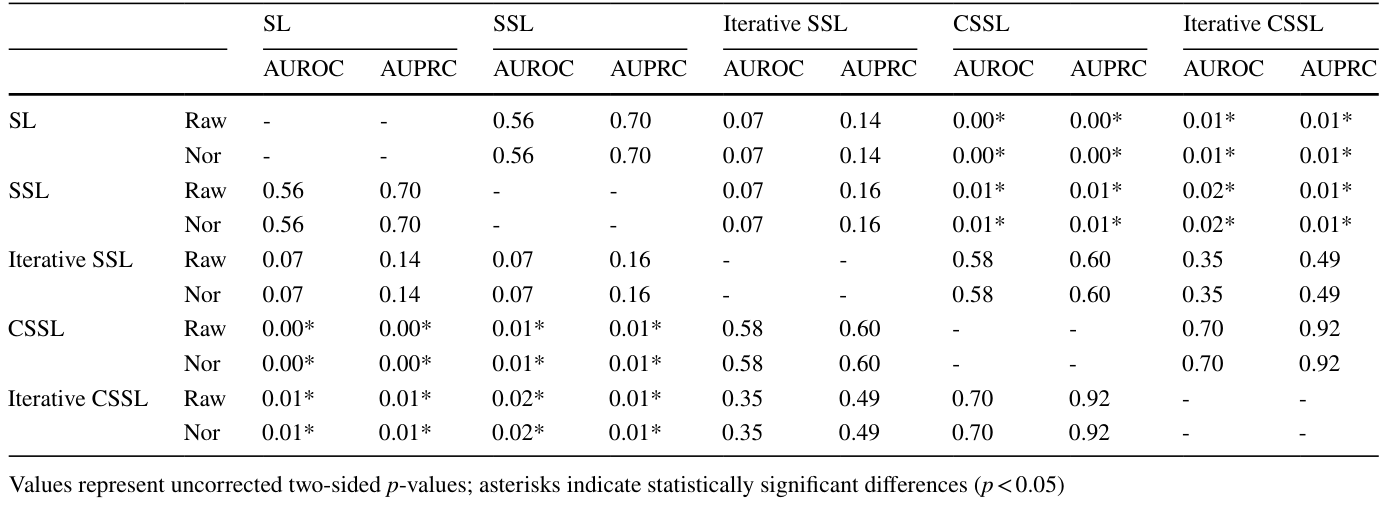
Table 4. Table 4 Pairwise statistical comparisons of AUROC (DeLong test) and AUPRC (paired bootstrap test) between modeling strategies for MGMT methylation prediction, shown separately for raw and threshold-normalized predictions解説: この表は、MGMTメチル化予測におけるモデリング戦略間のAUROC(DeLong検定)およびAUPRC(ペアブートストラップ検定)のペアワイズ統計比較を、生データと閾値正規化された予測についてそれぞれ示しています。値は未補正の両側p値であり、アスタリスクは統計的に有意な差(p < 0.05)を示します。
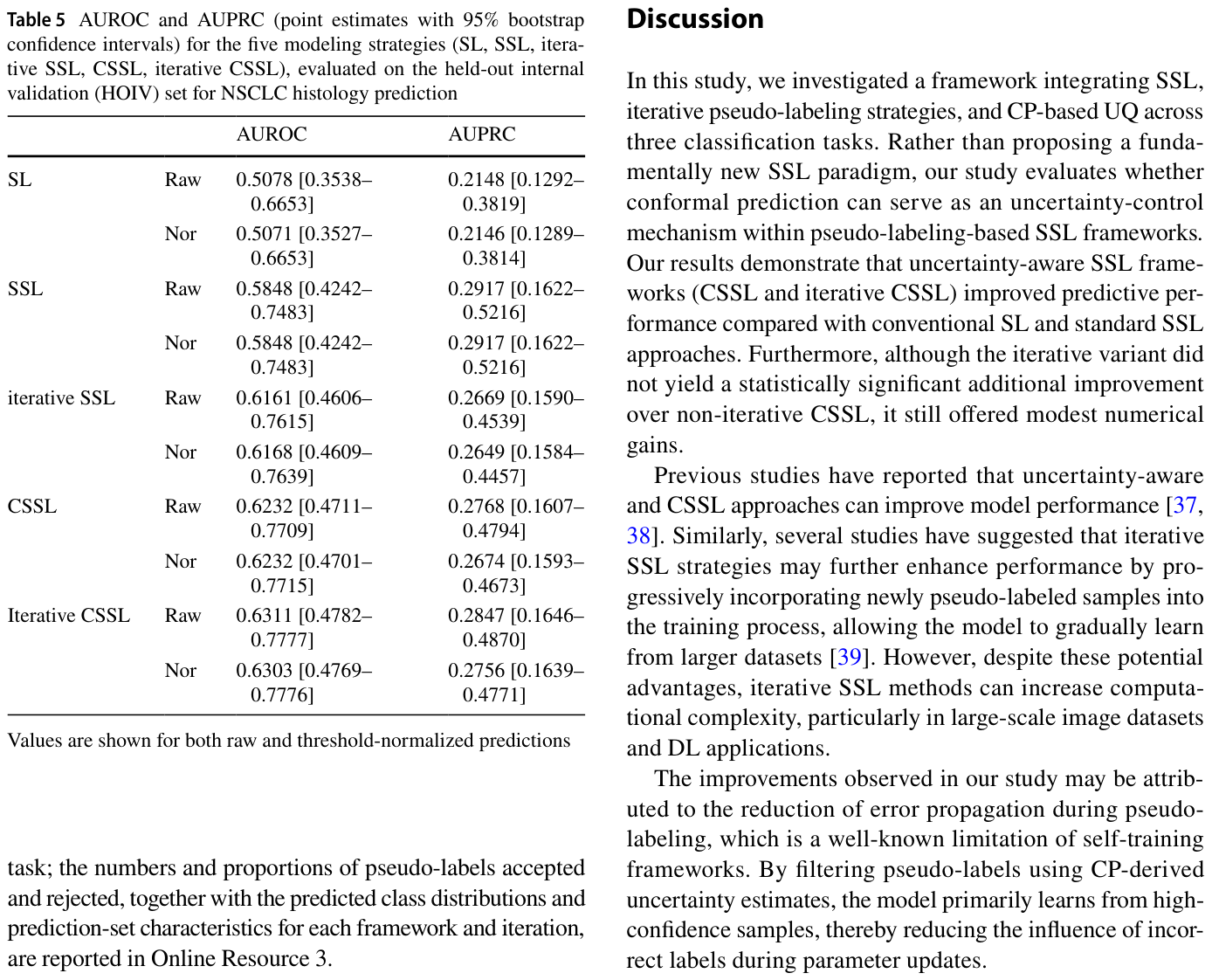
Table 5. Table 5 AUROC and AUPRC (point estimates with 95% bootstrap confidence intervals) for the five modeling strategies (SL, SSL, itera- tive SSL, CSSL, iterative CSSL), evaluated on the held-out internal validation (HOIV) set for NSCLC histology prediction解説: この表は、NSCLC組織学的予測の内部検証セット(HOIV)で評価された、5つのモデリング戦略(SL、SSL、反復SSL、CSSL、反復CSSL)のAUROCおよびAUPRC(95%ブートストラップ信頼区間付きの点推定値)を示しています。
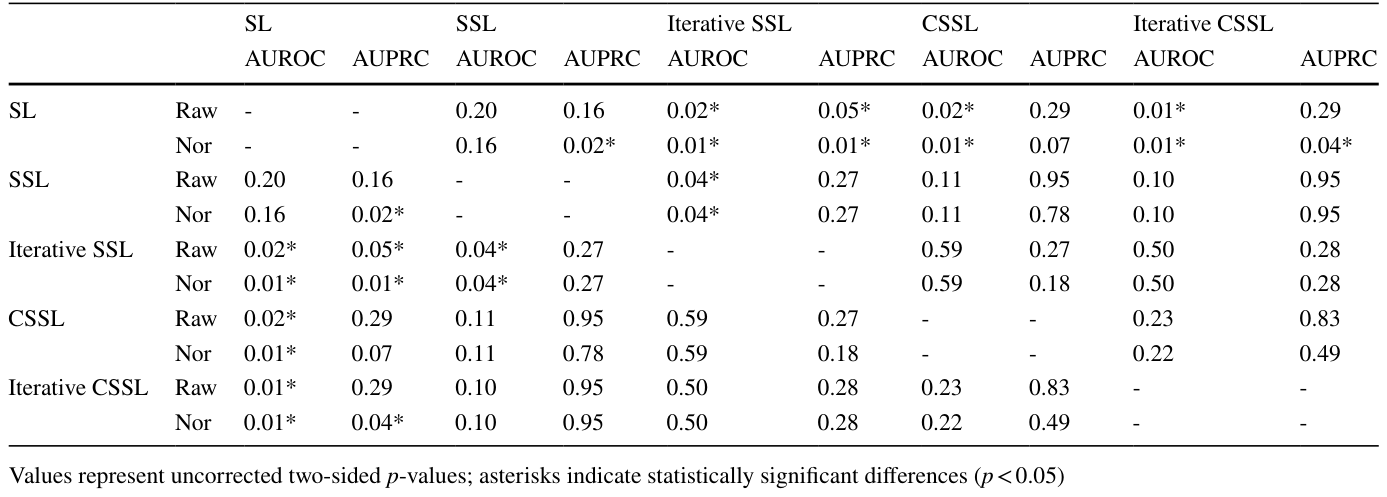
Table 6. Table 6 Pairwise statistical comparisons of AUROC (DeLong test) and AUPRC (paired bootstrap test) between modeling strategies for NSCLC histology prediction, shown separately for raw and threshold-normalized predictions解説: この表は、NSCLC組織学的予測におけるモデリング戦略間のAUROC(DeLong検定)およびAUPRC(ペアブートストラップ検定)のペアワイズ統計比較を、生データと閾値正規化された予測についてそれぞれ示しています。値は未補正の両側p値であり、アスタリスクは統計的に有意な差(p < 0.05)を示します。
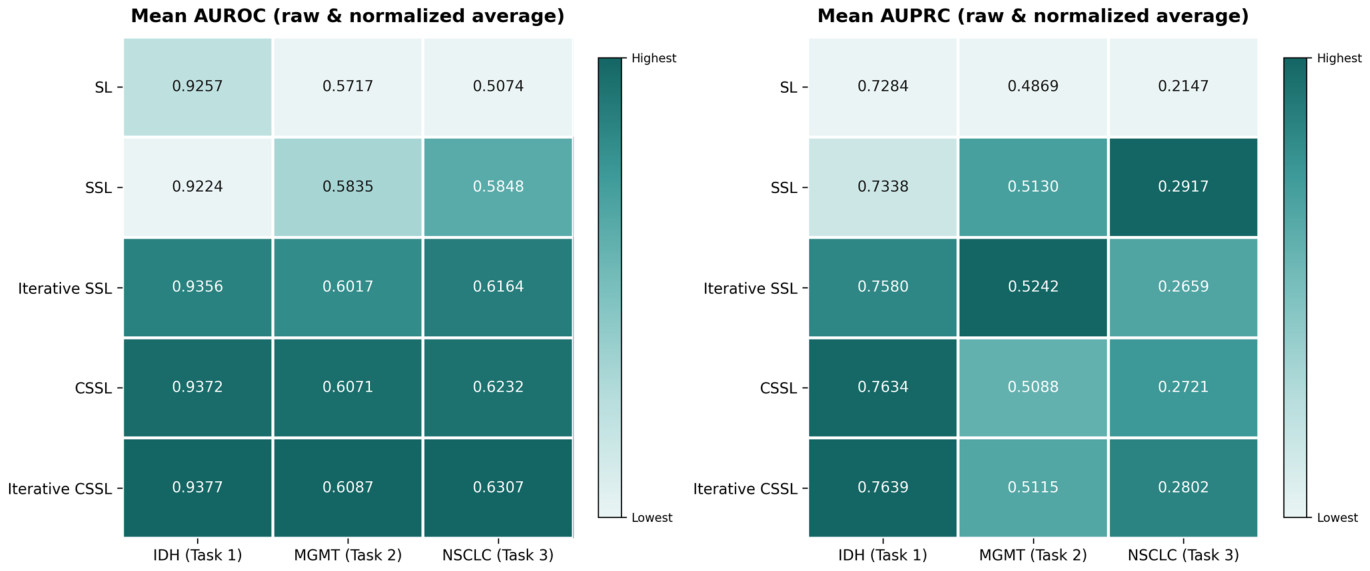
Figure 3. Fig. 3 Mean AUROC (left) and mean AUPRC (right) for each mod- eling strategy (SL, SSL, iterative SSL, CSSL, iterative CSSL) across the three prediction tasks (IDH, MGMT, NSCLC), averaged across raw and threshold-normalized predictions. Cell color reflects the rela-解説: この図は、3つの予測タスク(IDH、MGMT、NSCLC)における各モデリング戦略(SL、SSL、反復SSL、CSSL、反復CSSL)の平均AUROC(左)と平均AUPRC(右)を、生データと閾値正規化された予測の平均値で示しています。セルの色は各タスク列内の相対値を示し、色が濃いほど性能が高いことを意味します。数値は各モデルとタスクの組み合わせに対する平均AUROC/AUPRCです。
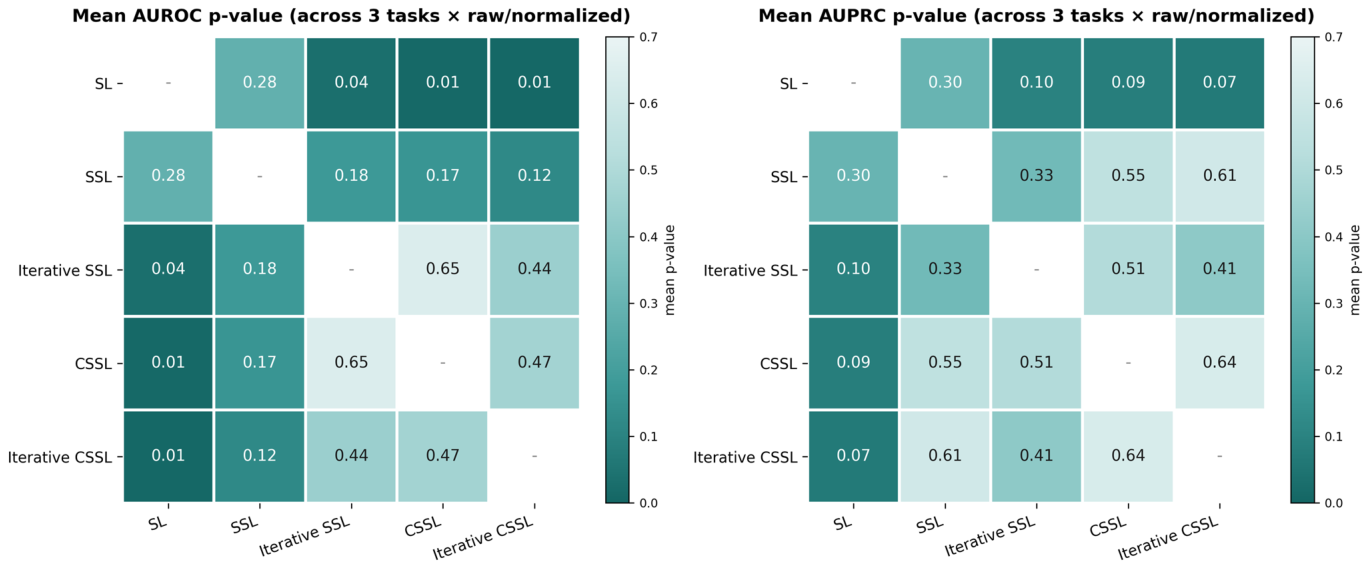
Figure 4. Fig. 4 Mean pairwise p-values for AUROC (left, DeLong test) and AUPRC (right, paired bootstrap) comparisons between modeling strategies, averaged across the three prediction tasks and both raw and解説: この図は、3つの予測タスクと生データおよび正規化された予測の両方について平均化された、モデリング戦略間のAUROC(左、DeLong検定)およびAUPRC(右、ペアブートストラップ)比較における平均ペアワイズp値をまとめたものです。色が濃いセルほど平均p値が低い(戦略間に強い差がある証拠)ことを示し、対角線上のセルは該当しません。

コメントを残す