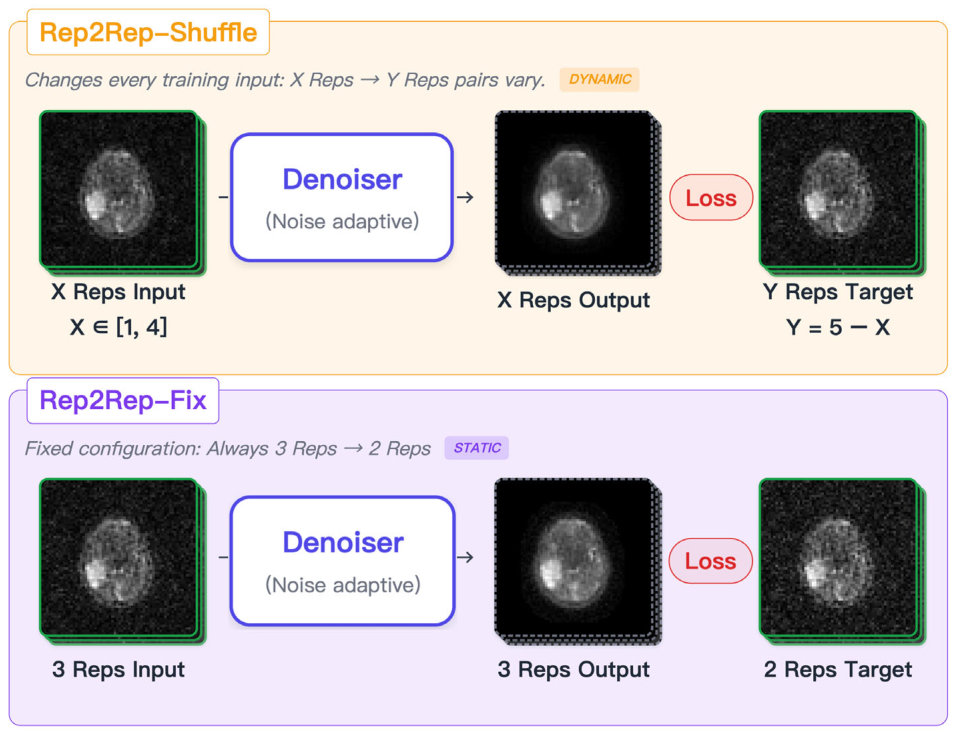
Figure 1. FIGURE 1 | Schematic overview of the Rep2Rep-Shuffle and Rep2Rep-Fix denoising pipelines. Rep2Rep-Shuffle dynamically varies repetition pair- ing during training, where a subset of repetitions is randomly selected as input during training and the remaining repetitions form the training target. In contrast, Rep2Rep-Fix uses a fixed pairing strategy, where a fixed number of repetitions are averaged as input and the remaining repetitions are used as targets throughout training.解説: Rep2Rep-ShuffleとRep2Rep-Fixのノイズ除去パイプラインの概要図。Rep2Rep-Shuffleは訓練中に繰り返しペアリングを動的に変更し、Rep2Rep-Fixは固定のペアリング戦略を使用します。
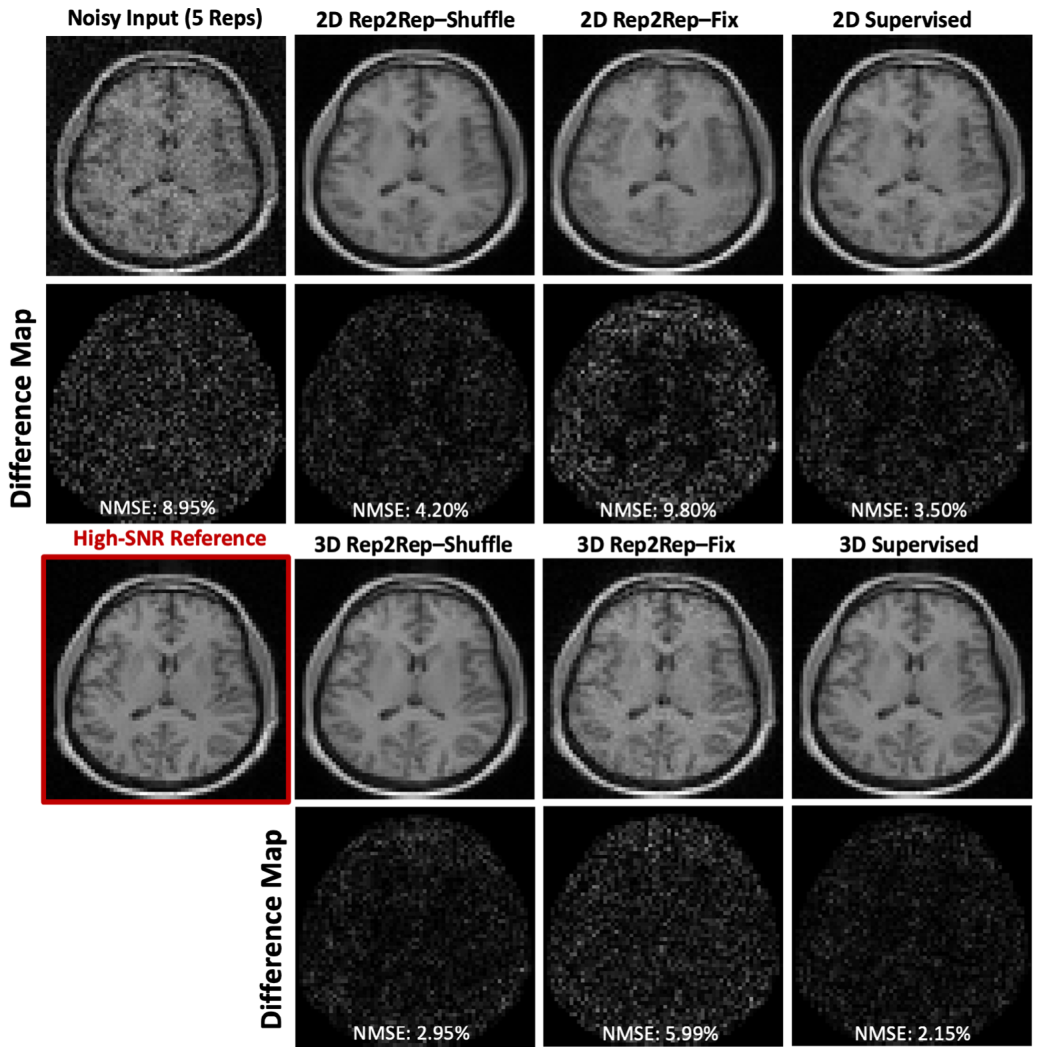
Figure 2. FIGURE 2 | Representative synthetic MRI results comparing 2D Rep2Rep-Shuffle, 2D Rep2Rep-Fix, 2D supervised denoising, 3D Rep2Rep-Shuffle, 3D Rep2Rep-Fix, and 3D supervised denoising using five repetitions for inference. The noisy input, high-SNR reference image, corresponding difference maps, and NMSE values are shown. Rep2Rep-Shuffle improved denoising performance over Rep2Rep-Fix, and the 3D implementation better preserved anatomical structures than the 2D implementation.解説: 合成MRIの代表的なノイズ除去結果を比較しています。2D Rep2Rep-Shuffle、2D Rep2Rep-Fix、2D教師あり学習、3D Rep2Rep-Shuffle、3D Rep2Rep-Fix、および3D教師あり学習を、推論に5回の繰り返しを使用した場合で示しています。Rep2Rep-ShuffleはRep2Rep-Fixよりもノイズ除去性能が向上し、3D実装は2D実装よりも解剖学的構造を良く保存しています。
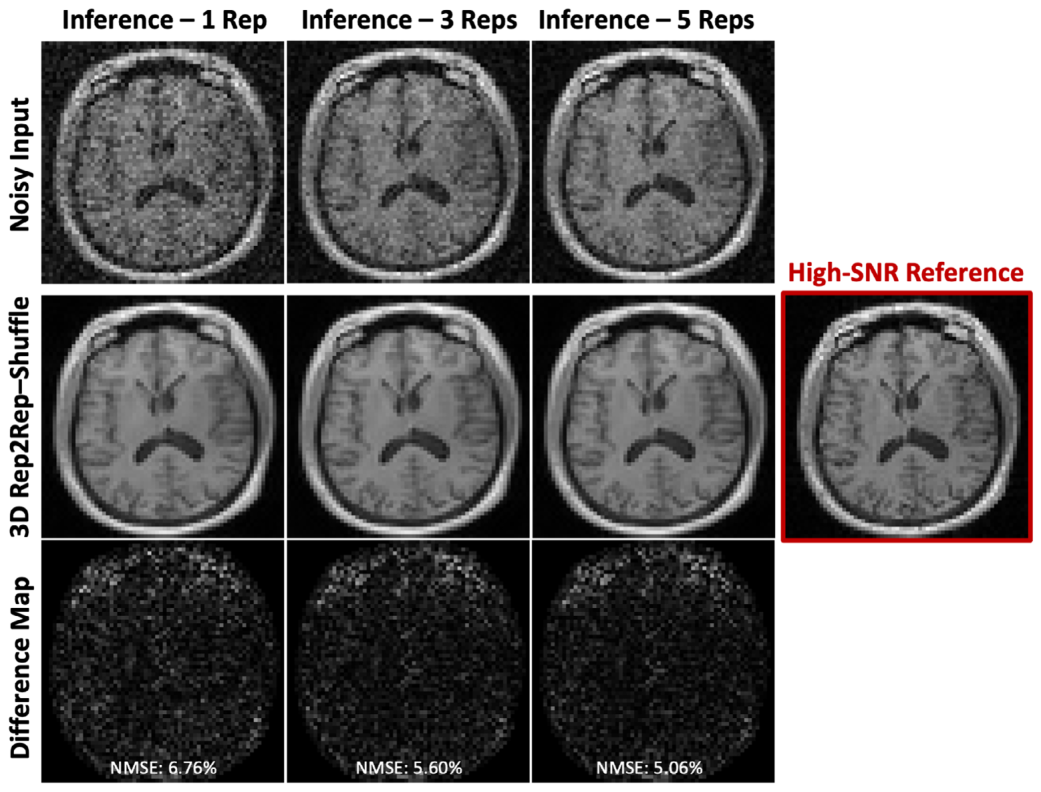
Figure 3. FIGURE 3 | Effect of inference repetition number on 3D Rep2Rep-Shuffle in synthetic MRI. The model was trained using five repetitions and tested using images averaged from one, three, and five repetitions. The corresponding noisy inputs, denoised images, difference maps, and high-SNR reference are shown, together with NMSE values. Image quality improved progressively as more repetitions were used for inference.解説: 合成MRIにおける3D Rep2Rep-Shuffleの推論繰り返し回数の影響を示します。モデルは5回の繰り返しで訓練され、1回、3回、5回平均化された画像でテストされました。推論に多くの繰り返しを使用するにつれて画質が徐々に向上しています。
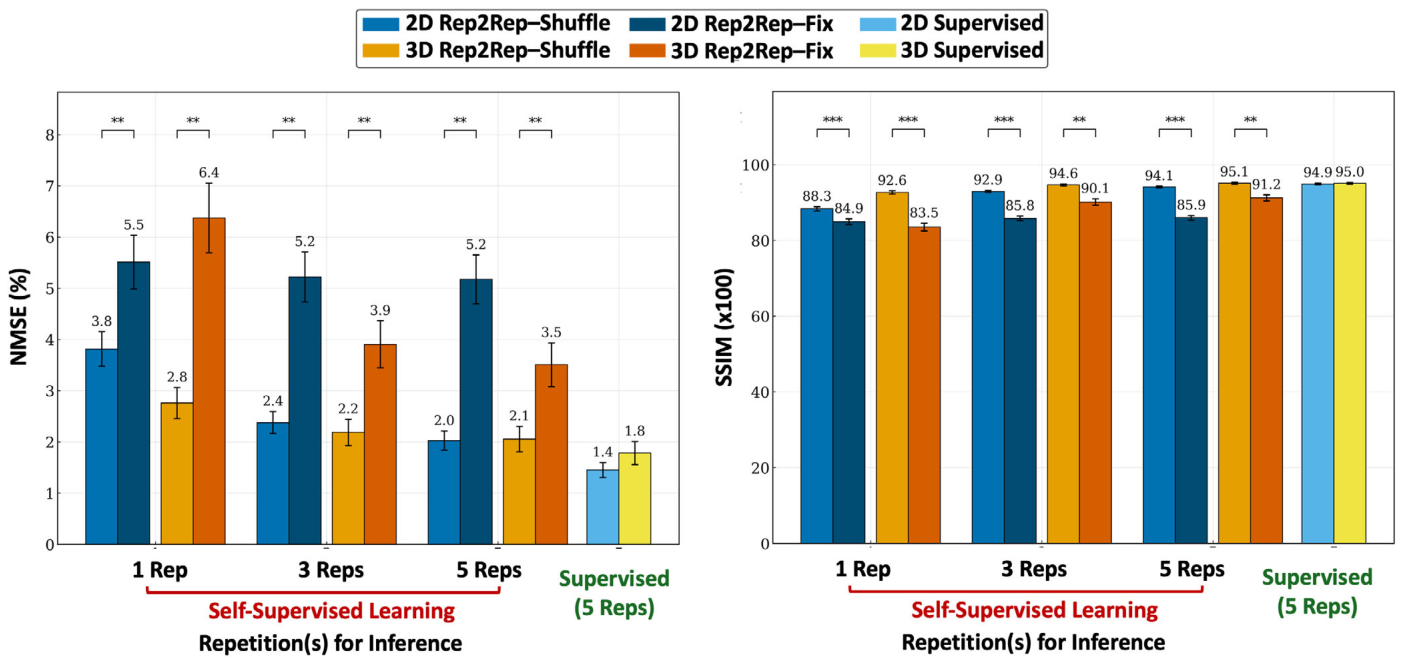
Figure 4. FIGURE 4 | Quantitative evaluation of synthetic MRI denoising performance. Bar plots show NMSE and SSIM for different methods using one, three, and five repetitions for inference. Rep2Rep-Shuffle demonstrates improved performance compared with Rep2Rep-Fix for all repetition settings, and the 3D denoising achieves better overall performance than 2D denoising.解説: 合成MRIノイズ除去性能の定量的評価です。棒グラフは、推論に1回、3回、5回の繰り返しを使用した異なる手法のNMSE(正規化平均二乗誤差)とSSIM(構造的類似性指数)を示しています。Rep2Rep-Shuffleは、すべての繰り返し設定でRep2Rep-Fixよりも性能が向上し、3Dノイズ除去は2Dノイズ除去よりも全体的に優れた性能を達成しています。
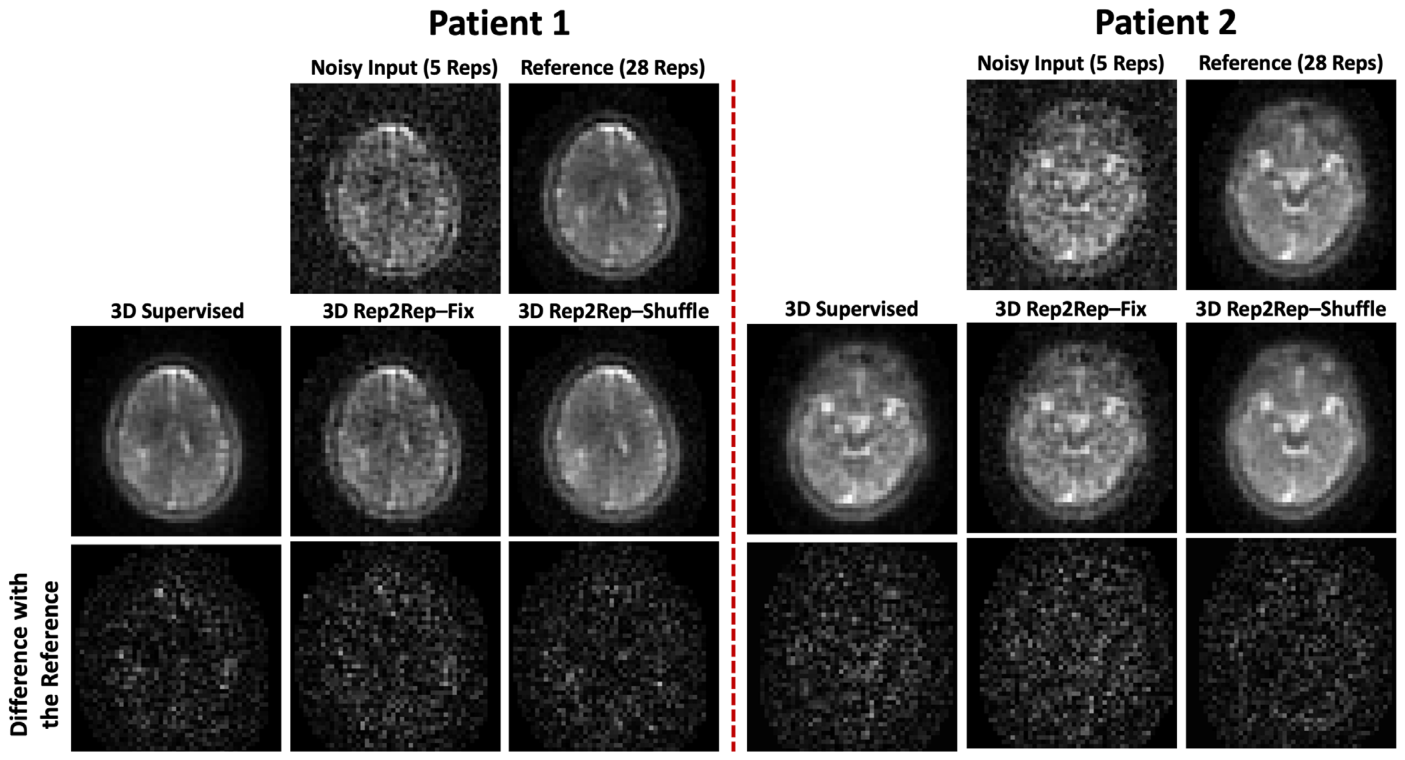
Figure 5. FIGURE 5 | Representative sodium MRI results from two patients comparing 3D Rep2Rep-Fix, 3D Rep2Rep-Shuffle, and 3D supervised denoising using five repetitions for inference. The corresponding noisy input (5 repetitions) and reference image (28 repetitions) are also shown, and difference maps relative to the reference are displayed in the bottom row. Rep2Rep-Shuffle provided improved noise suppression and anatomical preservation compared with Rep2Rep-Fix.解説: 2名の対象者からの代表的なナトリウムMRIノイズ除去結果を比較しています。3D Rep2Rep-Fix、3D Rep2Rep-Shuffle、および3D教師ありノイズ除去を、推論に5回の繰り返しを使用した場合で示しています。Rep2Rep-ShuffleはRep2Rep-Fixと比較して、ノイズ抑制と解剖学的保存が改善されています。
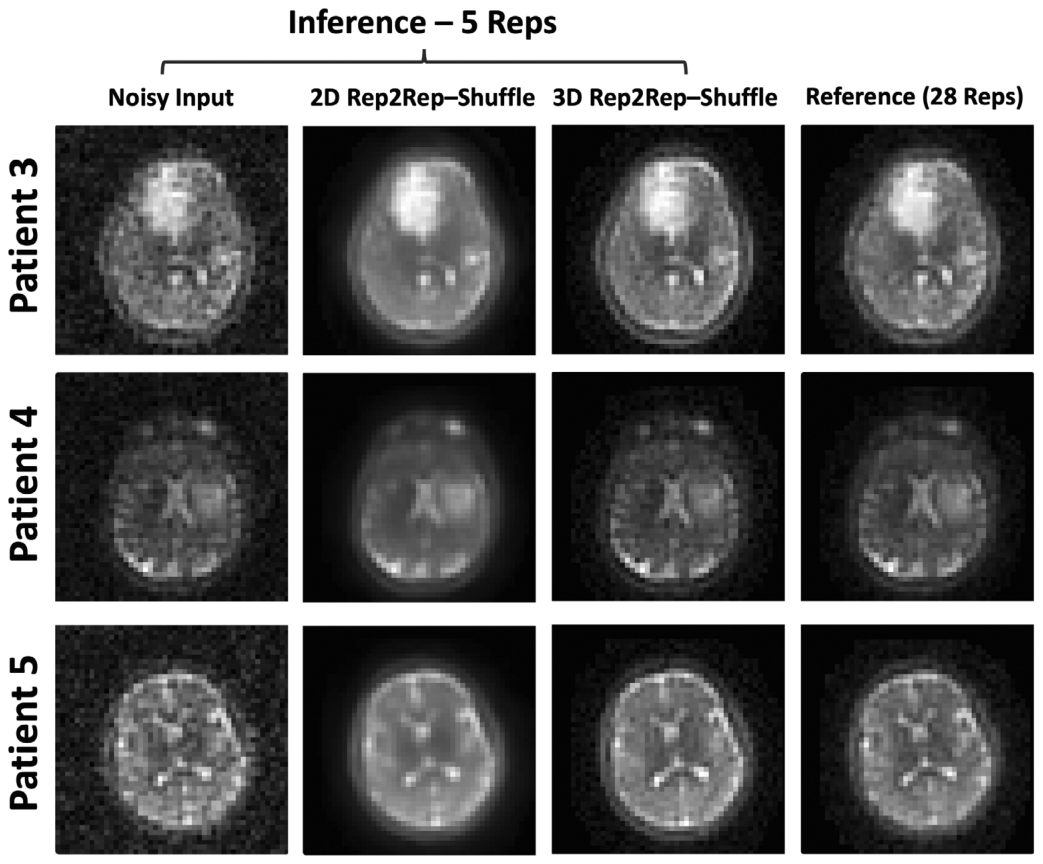
Figure 6. FIGURE 6 | Comparison between 2D Rep2Rep-Shuffle and 3D Rep2Rep-Shuffle in sodium MRI from three additional patients using five repetitions for inference. The 3D model better preserved anatomical structures and image contrast, whereas the 2D model suffered from substantial over-smoothing.解説: ナトリウムMRIにおける2D Rep2Rep-Shuffleと3D Rep2Rep-Shuffleの比較です。3名の追加の対象者から、推論に5回の繰り返しを使用した場合の結果を示します。3Dモデルは解剖学的構造と画像コントラストをより良く保持しているのに対し、2Dモデルは実質的な過剰平滑化に苦しんでいます。
これは、スライス間の空間的相関を利用する利点を示しています。
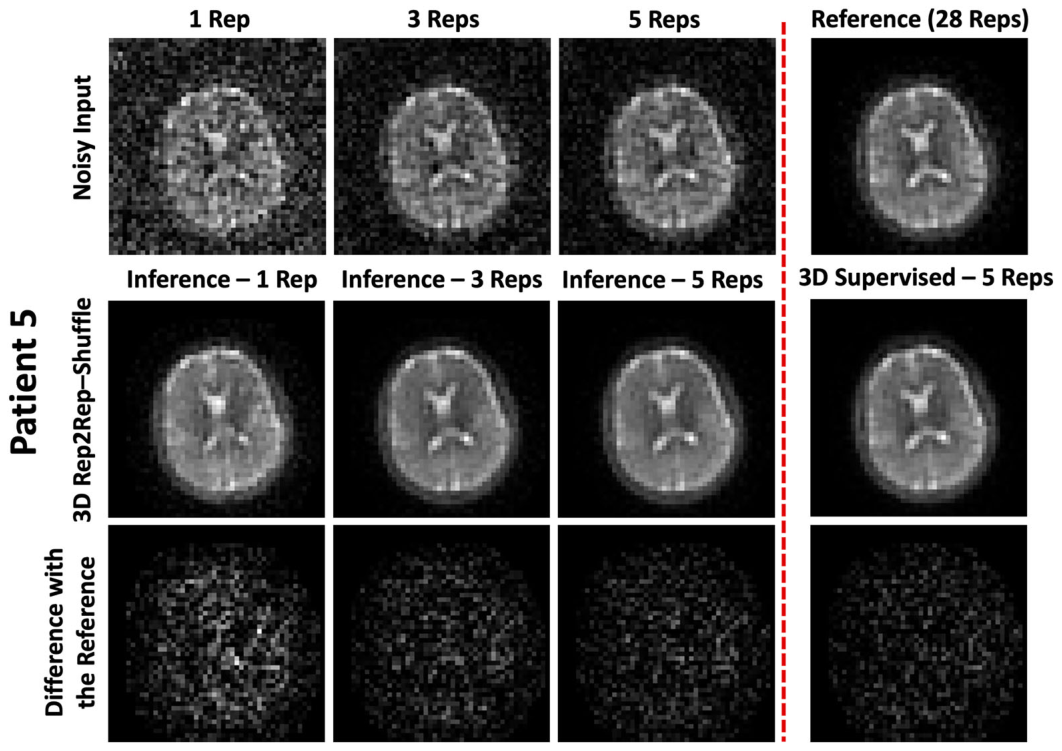
Figure 7. FIGURE 7 | Effect of inference repetition number on 3D Rep2Rep-Shuffle in sodium MRI. The model was trained using five repetitions and eval- uated using inputs averaged from one, three, and five repetitions. The corresponding noisy inputs, denoised images, difference maps, 3D supervised result (5 repetitions), and reference image (28 repetitions) are shown. Image quality improved with increasing repetitions during inference.解説: ナトリウムMRIにおける3D Rep2Rep-Shuffleの推論繰り返し回数の影響です。モデルは5回の繰り返しで訓練され、1回、3回、5回平均化された入力で評価されました。推論中の繰り返し回数が増えるにつれて画質が向上しています。
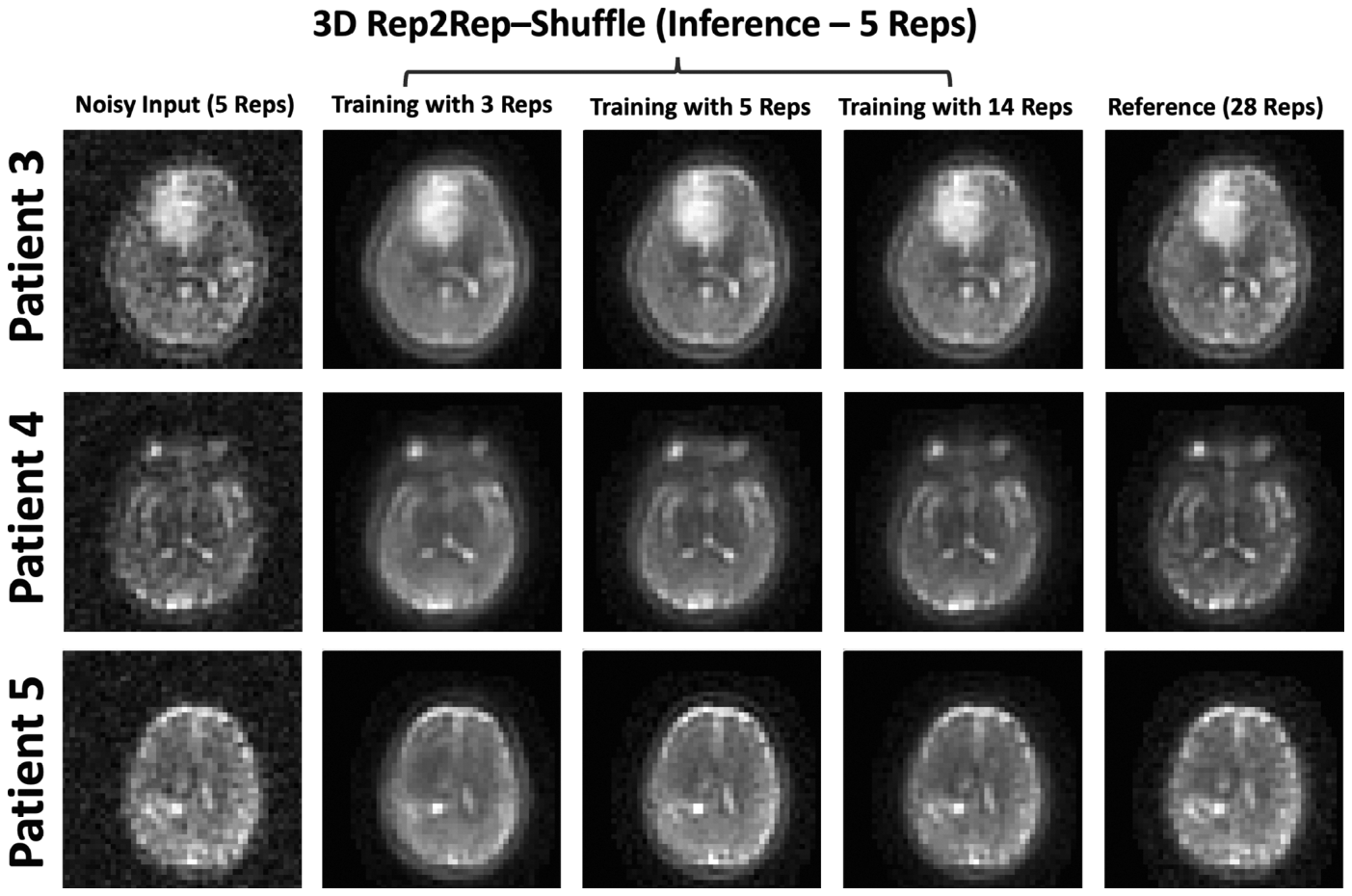
Figure 8. FIGURE 8 | Effect of the number of repetitions used during training on 3D Rep2Rep-Shuffle in sodium MRI. Models were trained using 3, 5, and 14 repetitions and evaluated using 5 repetitions for inference. The corresponding noisy input (5 repetitions) and reference image (28 repetitions) are shown. Training with five repetitions improved performance over training with 3 repetitions, while further improvement from 5 to 14 repetitions was modest.解説: ナトリウムMRIにおける3D Rep2Rep-Shuffleの訓練時に使用する繰り返し回数の影響です。モデルは3回、5回、14回の繰り返しを使用して訓練され、推論は5回の繰り返しで行われました。3回の繰り返しでの訓練よりも5回の繰り返しでの訓練で性能が向上し、5回から14回へのさらなる改善はわずかでした。
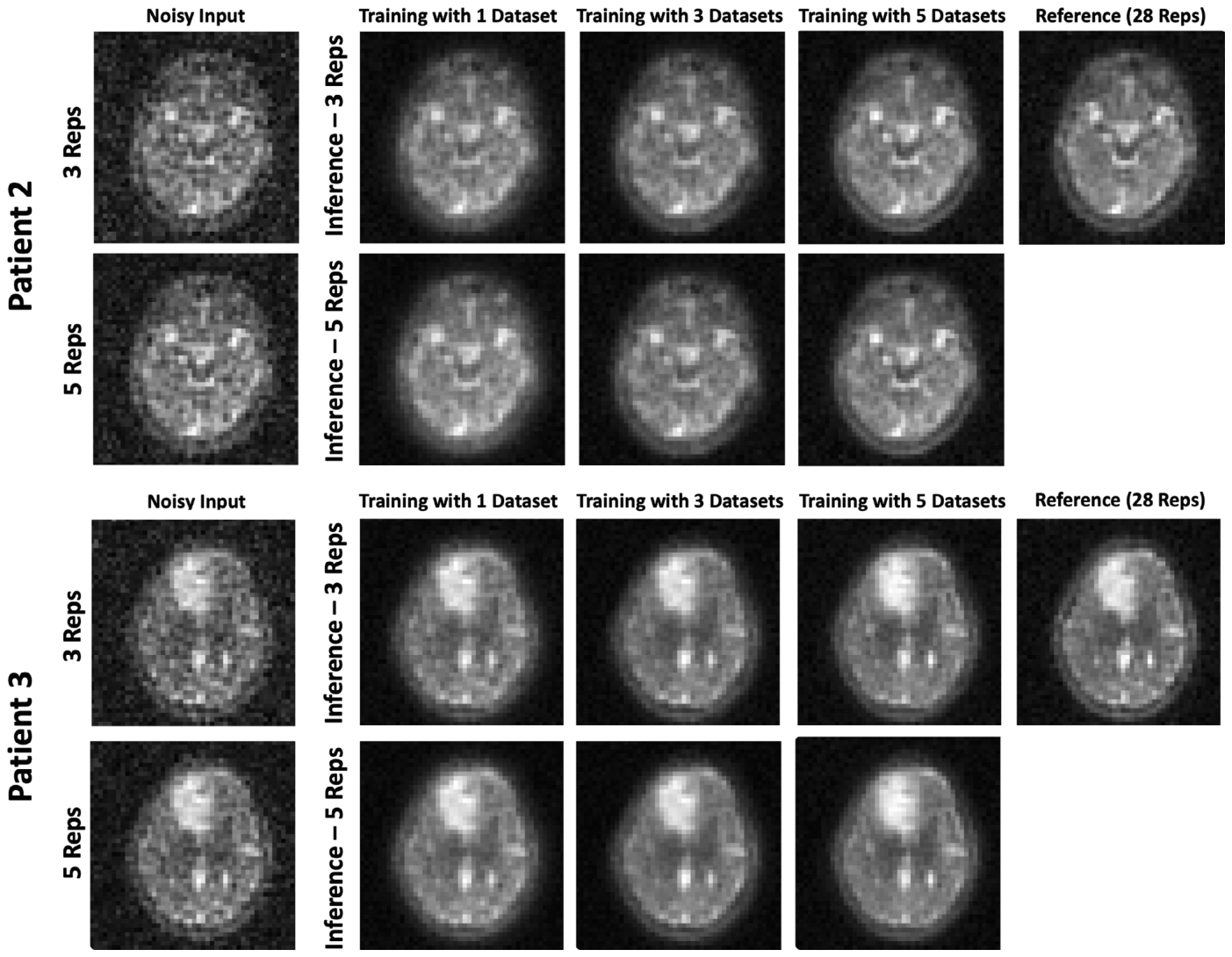
Figure 9. FIGURE 9 | Effect of training dataset size on 3D Rep2Rep-Shuffle in sodium MRI. Models were trained using one, three, and five datasets and evaluated using both three and five repetitions for inference. Representative results from two patients are shown together with the corresponding noisy inputs and reference images (28 repetitions). Increasing the number of training datasets improved image quality and the overall performance of denoising.解説: ナトリウムMRIにおける3D Rep2Rep-Shuffleの訓練データセットサイズの影響です。モデルは1つ、3つ、5つのデータセットを使用して独立して訓練され、推論は3回と5回の両方の繰り返しで行われました。訓練データセットの数を増やすと、画質とノイズ除去の全体的な性能が向上しました。
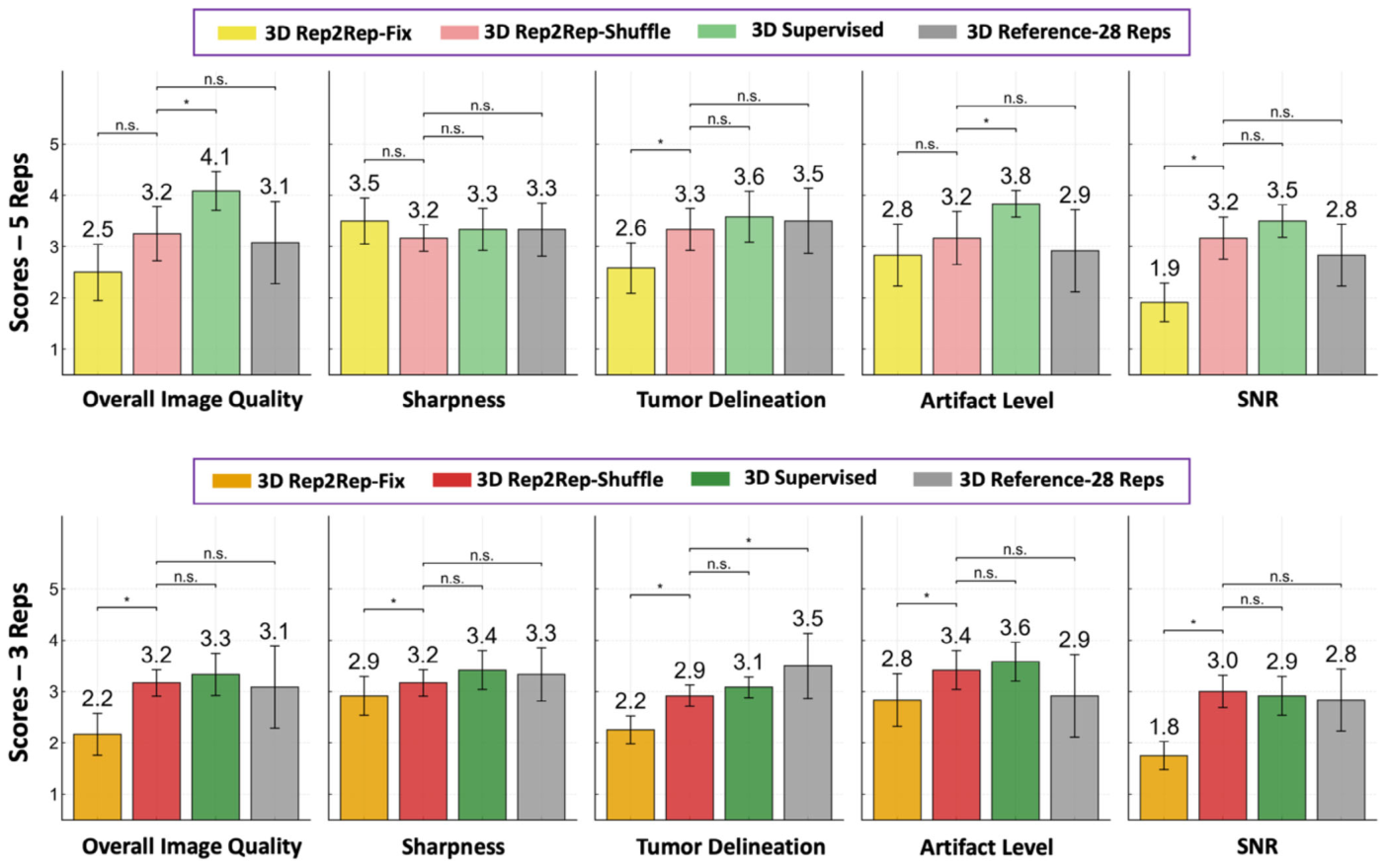
Figure 10. FIGURE 10 | Reader evaluation results for sodium MRI denoising. Scores are shown for overall image quality, sharpness, tumor delineation, artifact level, and SNR using both three and five repetitions for inference. The evaluated methods included 3D Rep2Rep-Shuffle, 3D Rep2Rep-Fix, 3D supervised, and the 3D reference image reconstructed from 28 repetitions. Statistical comparisons are indicated above the bar plots.解説: ナトリウムMRIノイズ除去の読影者評価結果です。全体的な画質、シャープネス、病変の境界、アーチファクトレベル、SNRについて、推論に3回と5回の繰り返しを使用した場合のスコアを示しています。
コメントを残す