どうも、Beyond the Pixelです。MRI(磁気共鳴画像)検査は、体の内部を詳細に可視化できる強力な診断ツールですが、検査中に身体が動いてしまうと、画像に「モーションアーチファクト」と呼ばれる歪みやブレが生じ、診断品質が大きく低下してしまいます。特に、小さなお子さんやご高齢の対象者、あるいは動きの障害を持つ対象者にとっては、じっと動きを止めておくことが難しく、これが再スキャンや検査時間の延長、ひいては医療施設における経済的負担の増大につながるケースもあります。
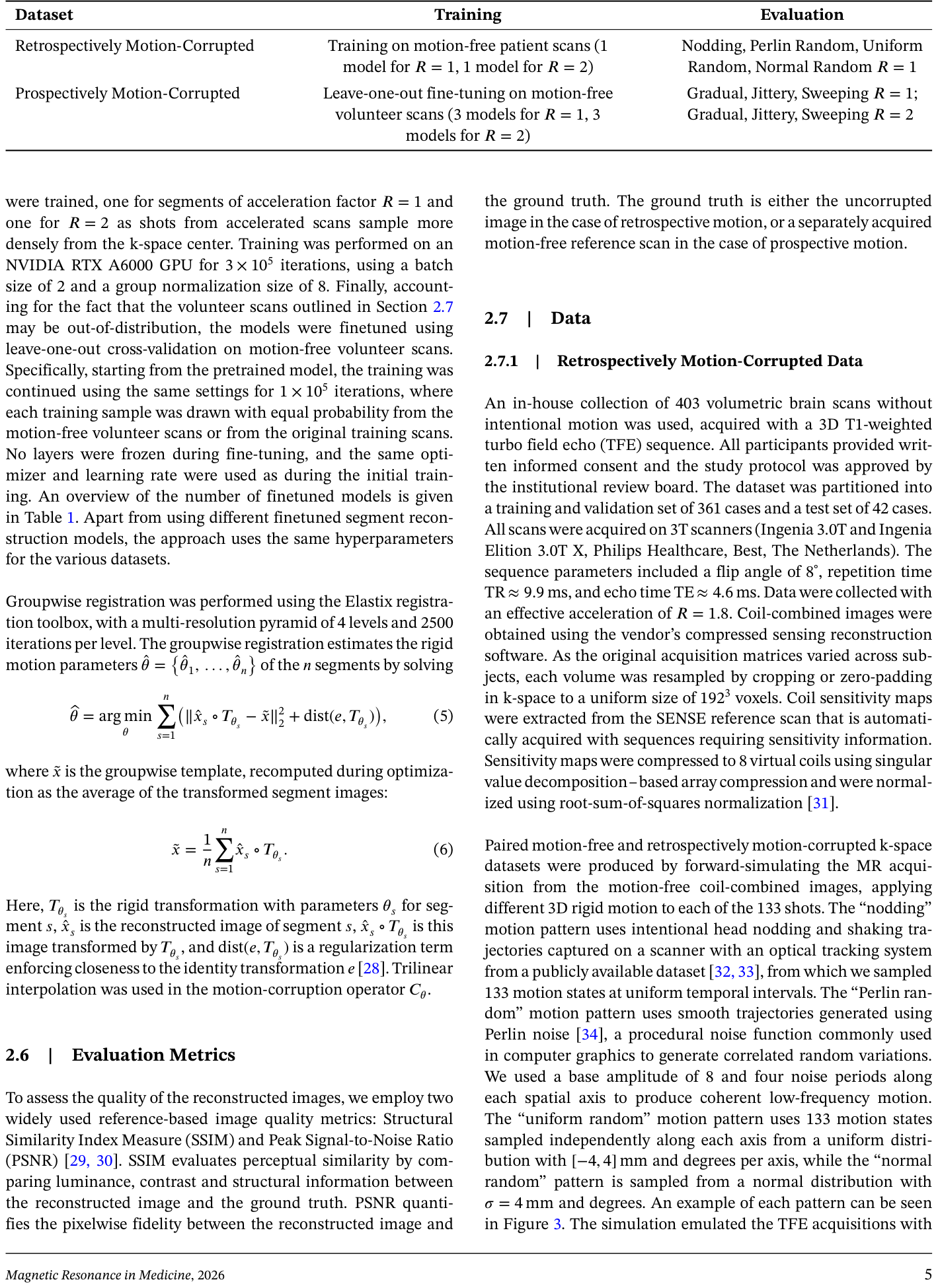
Table 1. TABLE 1 | Overview of the number of trained and finetuned segment reconstruction models, as well as an overview of the motion-corrupted datasets used for evaluation, where 𝑅stands for acceleration factor.解説: 訓練およびファインチューニングされたセグメント再構成モデルの数、ならびに評価に用いられたレトロスペクティブおよびプロスペクティブモーション汚染データセットの概要を示しています。Rは加速係数を表します。
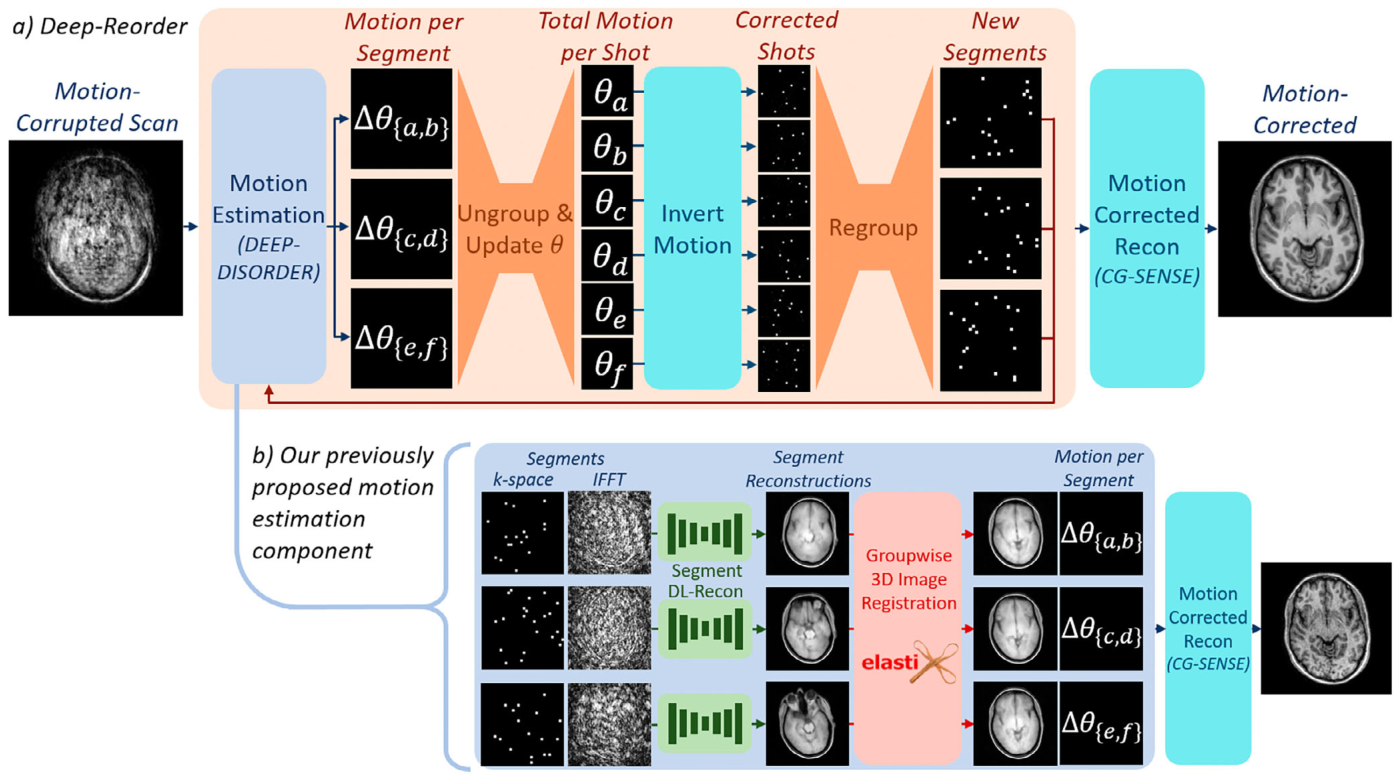
Figure 1. FIGURE 1 | (a) The proposed Deep-Reorder approach iteratively re-uses an existing motion estimation method. After motion is estimated for a segment, which consists of multiple shots (e.g., shots a and b), the individual motion parameters of those shots are updated accordingly. Next, the total parameters are used to correct the motion in the measured data, and new segments are made from different combinations of shots, for which more residual motion may be removed in the next iteration. In the end, each shot can be corrected with its own motion parameters in a final motion-corrected reconstruction. (b) The existing approach DEEP-DISORDER estimates motion on a per-segment basis.解説: 提案されたDeep-Reorderアプローチの反復的なモーション推定・補正プロセスと、著者らが以前に提案したモーション推定コンポーネントDEEP-DISORDERの概要を示しています。(a) Deep-Reorderは、モーション推定、ショットごとのモーション更新、モーション補正、およびショットの再編成というステップを繰り返し実行することで、モーション汚染されたスキャンを高画質のモーション補正済みスキャンへと導きます。(b) DEEP-DISORDERは、k空間フラクションから画像を再構成し、グループワイズレジストレーションによってセグメントごとのモーションを推定します。
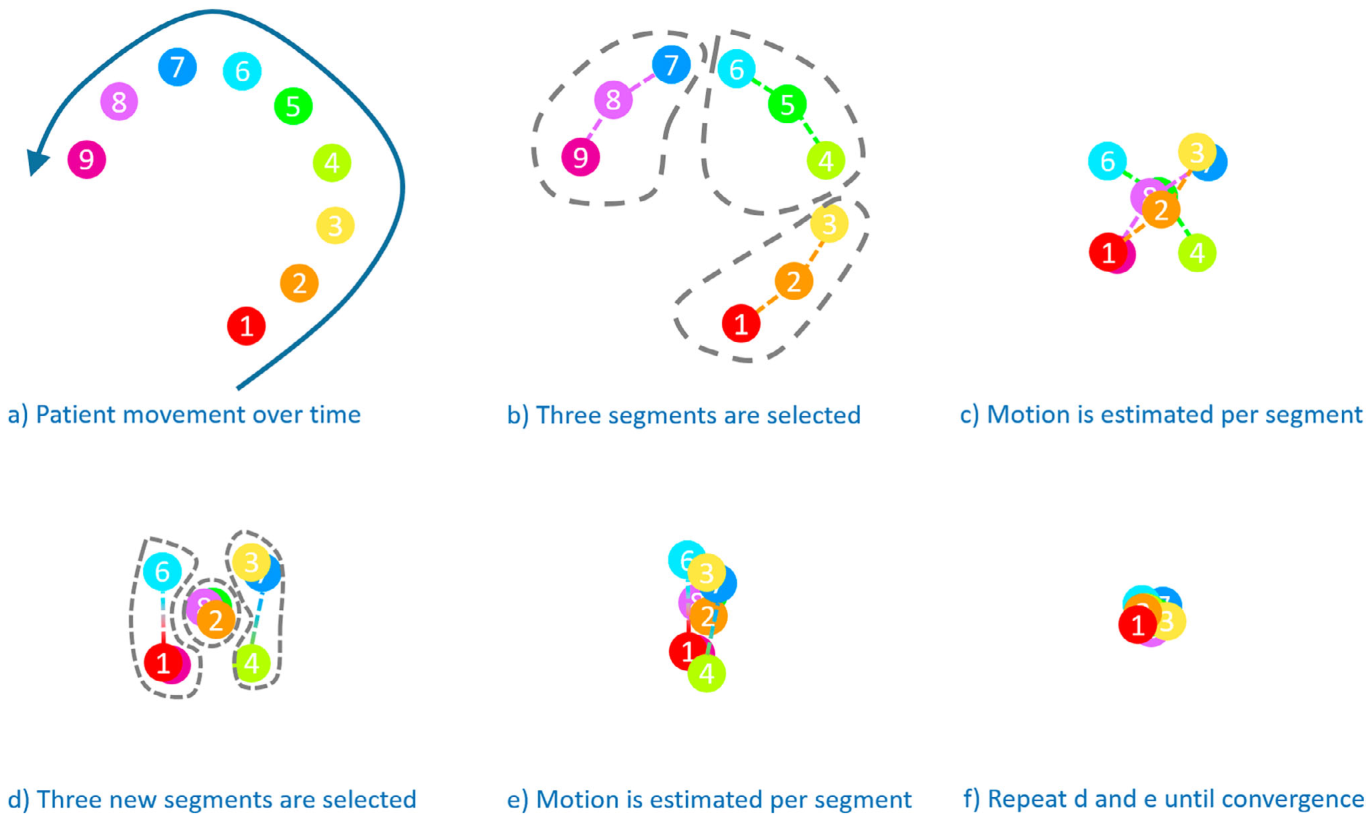
Figure 2. FIGURE 2 | Given a simplified motion-corrupted scan with 9 motion states (a), an existing motion correction algorithm accurately estimates motion for three segments, but cannot solve intrasegment motion (b, c). The proposed iterative regrouping algorithm improves the temporal resolution of the existing motion correction algorithm from 3 to 9 estimated motion states (d, e, f).解説: 簡略化された9つのモーション状態を持つスキャンにおいて、既存のモーション補正アルゴリズムと提案手法の反復再編成アルゴリズムによるモーション推定の比較を示しています。(a) 時間経過に伴う対象者の動き。(b, c) 既存のアルゴリズムでは3つのセグメントが選択され、セグメントごとにモーションが推定されるため、セグメント内のモーションは解決されません。(d, e, f) 提案する反復再編成アルゴリズムは、新しいセグメントを繰り返し作成し、モーションを推定することで、既存のアルゴリズムの時間分解能を3つの推定モーション状態から9つに向上させます。
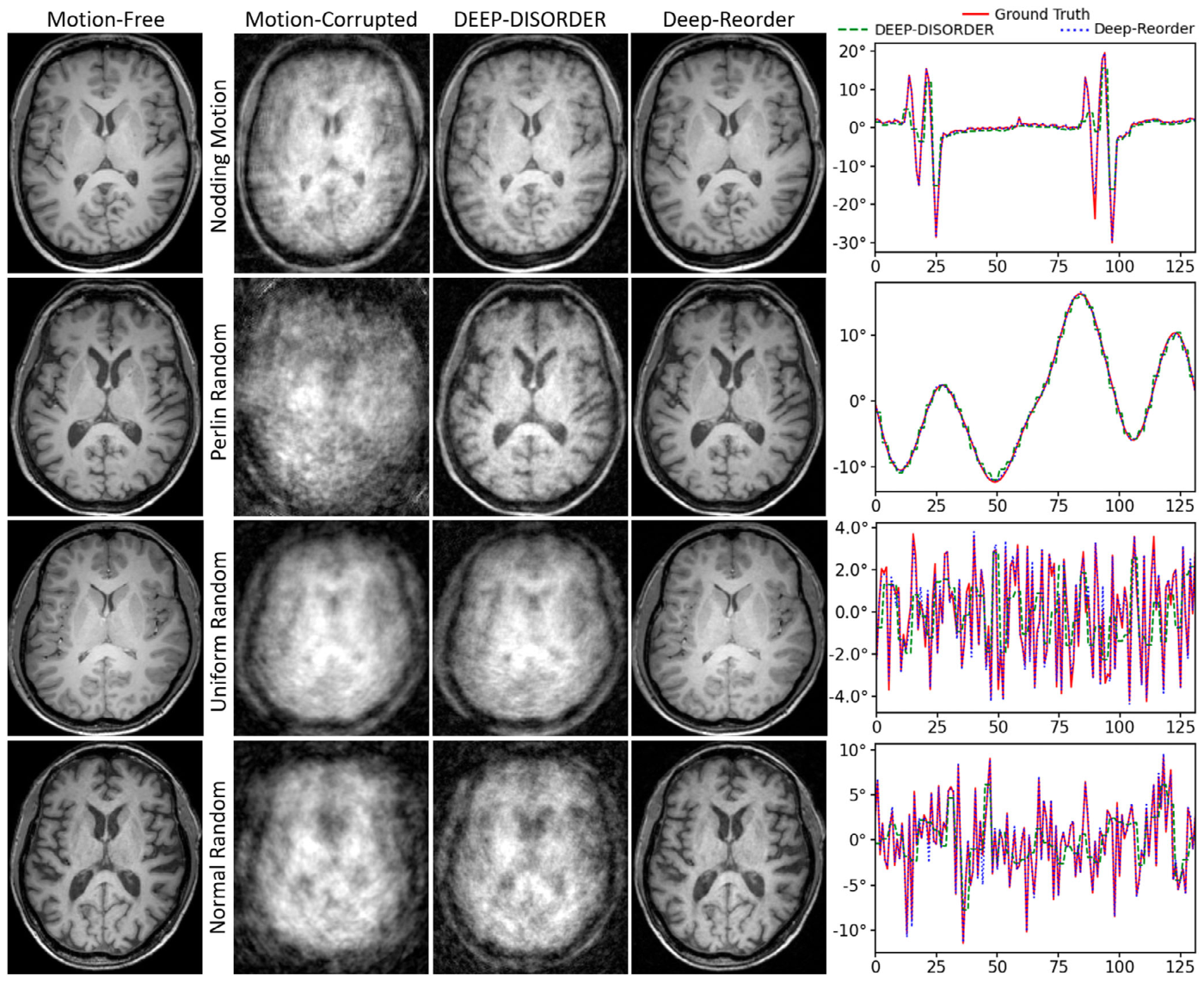
Figure 3. FIGURE 3 | Reconstructions of retrospectively motion-corrupted data with 132 motion states. The first row displays nodding motion from a tracking device. The second row displays a pattern sampled from Perlin noise. The pattern in the third row was generated using 132 motion states sampled uniformly over [−4, 4] mm or degrees per degree of freedom, while the fourth pattern was generated using a normal distribution with 𝜎= 4. The plots show the estimated and known rotational motion about the z-axis (feet-head).解説: レトロスペクティブにモーションを付与したデータにおける、未補正、DEEP-DISORDER、提案手法であるDeep-Reorderによる再構成画像と、推定された回転モーション(z軸周り)のプロットを示しています。Deep-Reorderは全てのモーションパターンにおいて、各ショット固有のモーション状態を推定し、モーションアーチファクトを大幅に低減しています。
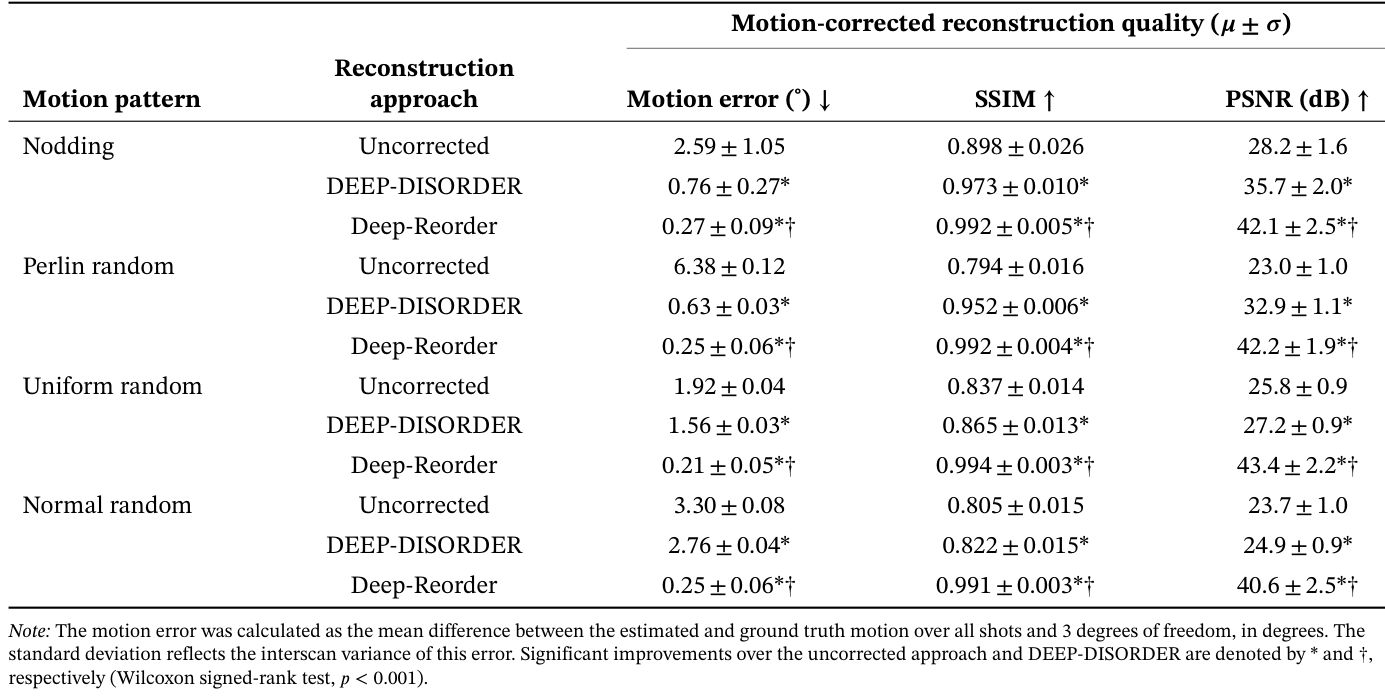
Table 2. TABLE 2 | Reconstruction quality and accuracy of the estimated motion on retrospectively motion-corrupted data.解説: レトロスペクティブにモーションを付与したデータにおける、再構成画像の品質と推定モーションの精度を定量的に比較した表です。Deep-Reorderが、未補正およびDEEP-DISORDERと比較して、モーション誤差の低減、SSIMおよびPSNRの向上の両方で統計的に有意な改善を示していることが示されています。
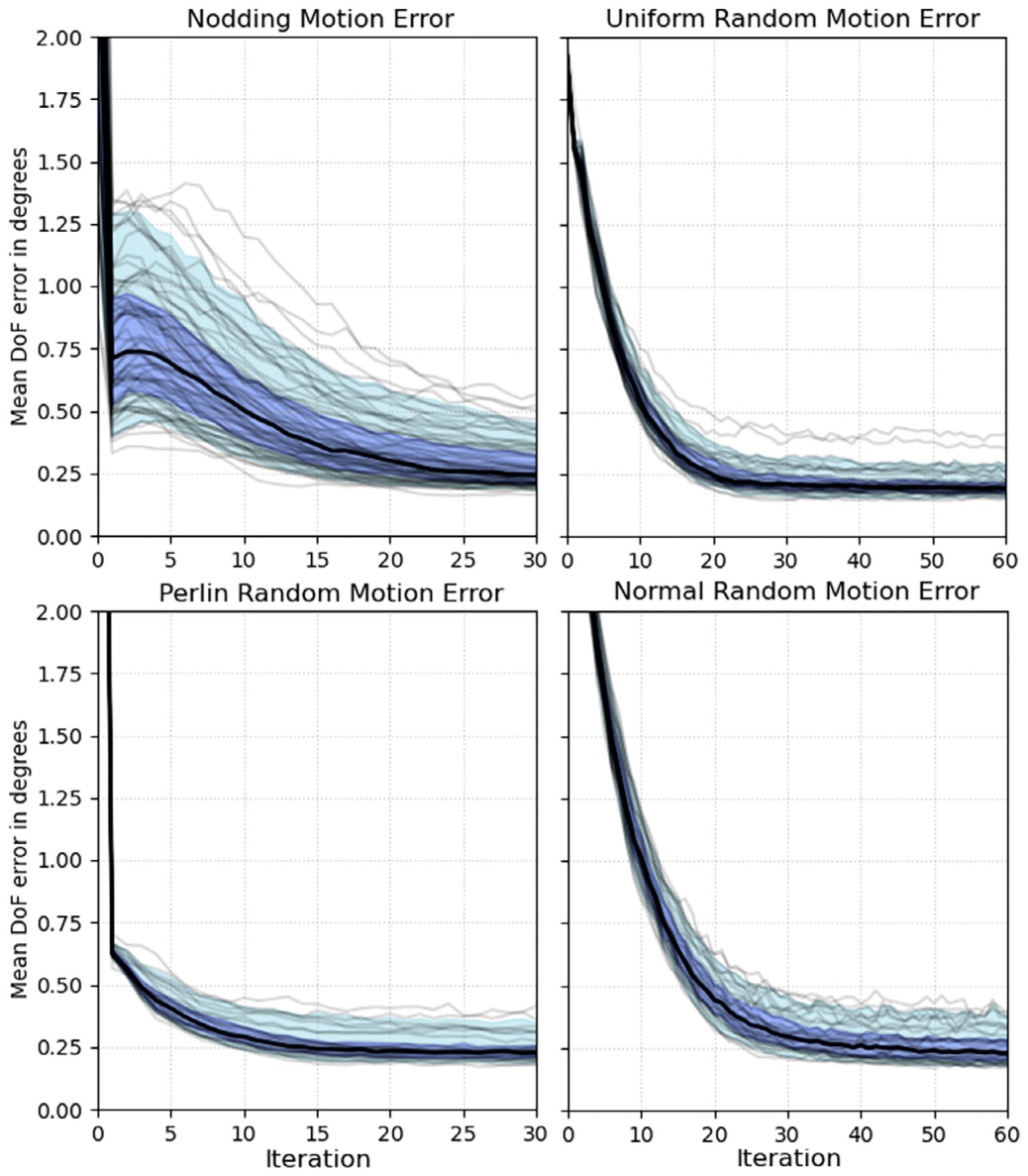
Figure 4. FIGURE 4 | Mean rotation error per degree of freedom over iterations between ground-truth motion patterns and estimations by Deep-Reorder for retrospectively corrupted data. Zero iterations corresponds to no correction while one iteration corresponds to the previously proposed approach DEEP-DISORDER.解説: レトロスペクティブにモーションを付与したデータについて、Deep-Reorderの反復回数ごとの各自由度における平均回転誤差の推移を示しています。反復を重ねるごとに推定誤差が徐々に減少し、解決策が改善していく様子が確認できます。Figure 5. FIGURE 5 | Correction quality across iterations on retrospectively motion-corrupted data with random motion. This example converged around 20 iterations, after which running more iterations had no meaningful effect.解説: ランダムモーションが付与されたレトロスペクティブモーション汚染データにおける、反復回数に応じた補正画像の品質変化を視覚的に示しています。反復が進むにつれて画質が向上し、モーションアーチファクトが減少していく様子が分かります。
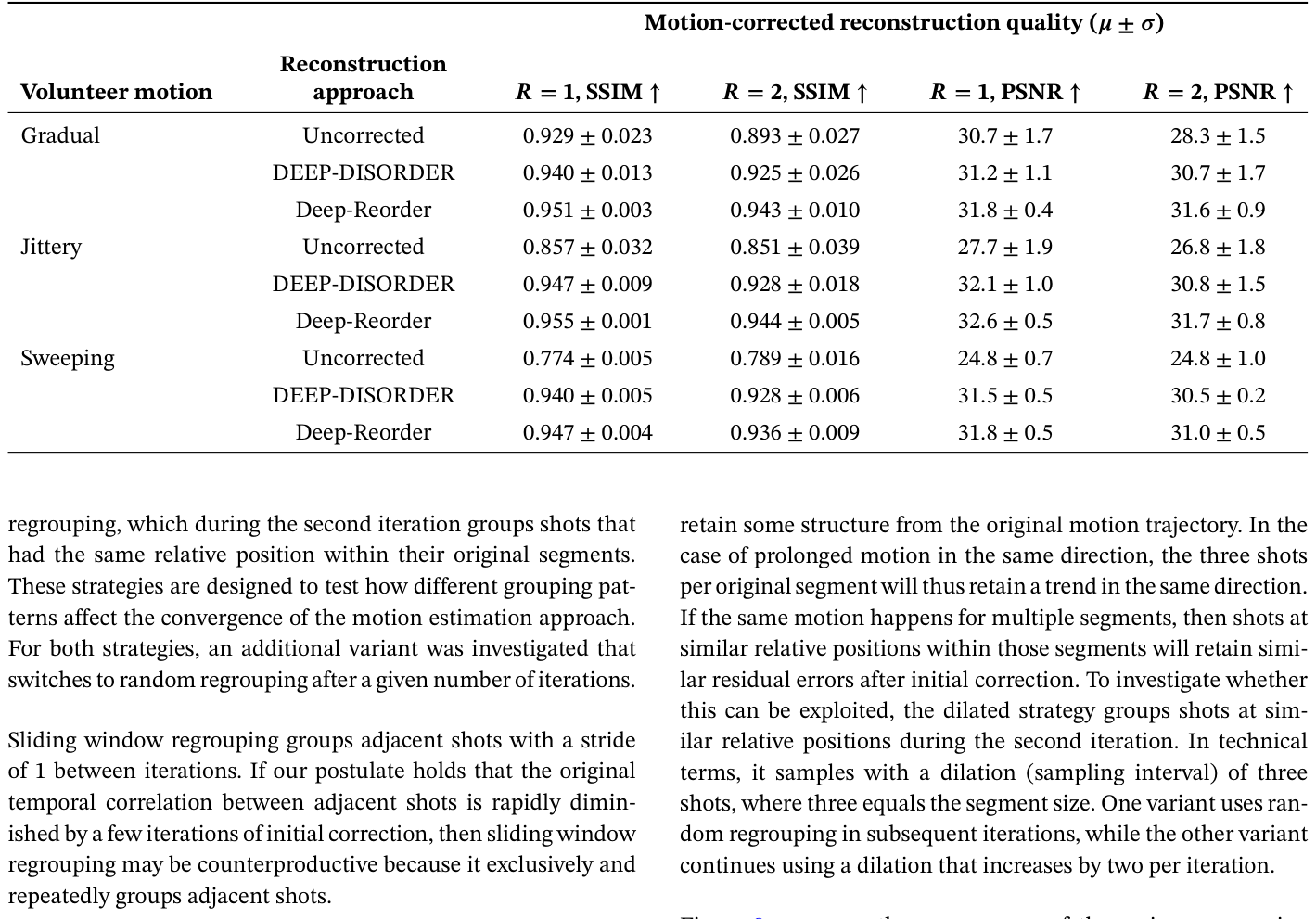
Table 3. TABLE 3 | Reconstruction quality on prospectively motion-corrupted data with intentional motion by volunteers.解説: 意図的な動きを伴うボランティアのプロスペクティブモーション汚染データにおける再構成品質を定量的に比較した表です。Deep-Reorderが、未補正およびDEEP-DISORDERと比較してSSIMとPSNRの両方で画像品質を向上させていることが示されています。
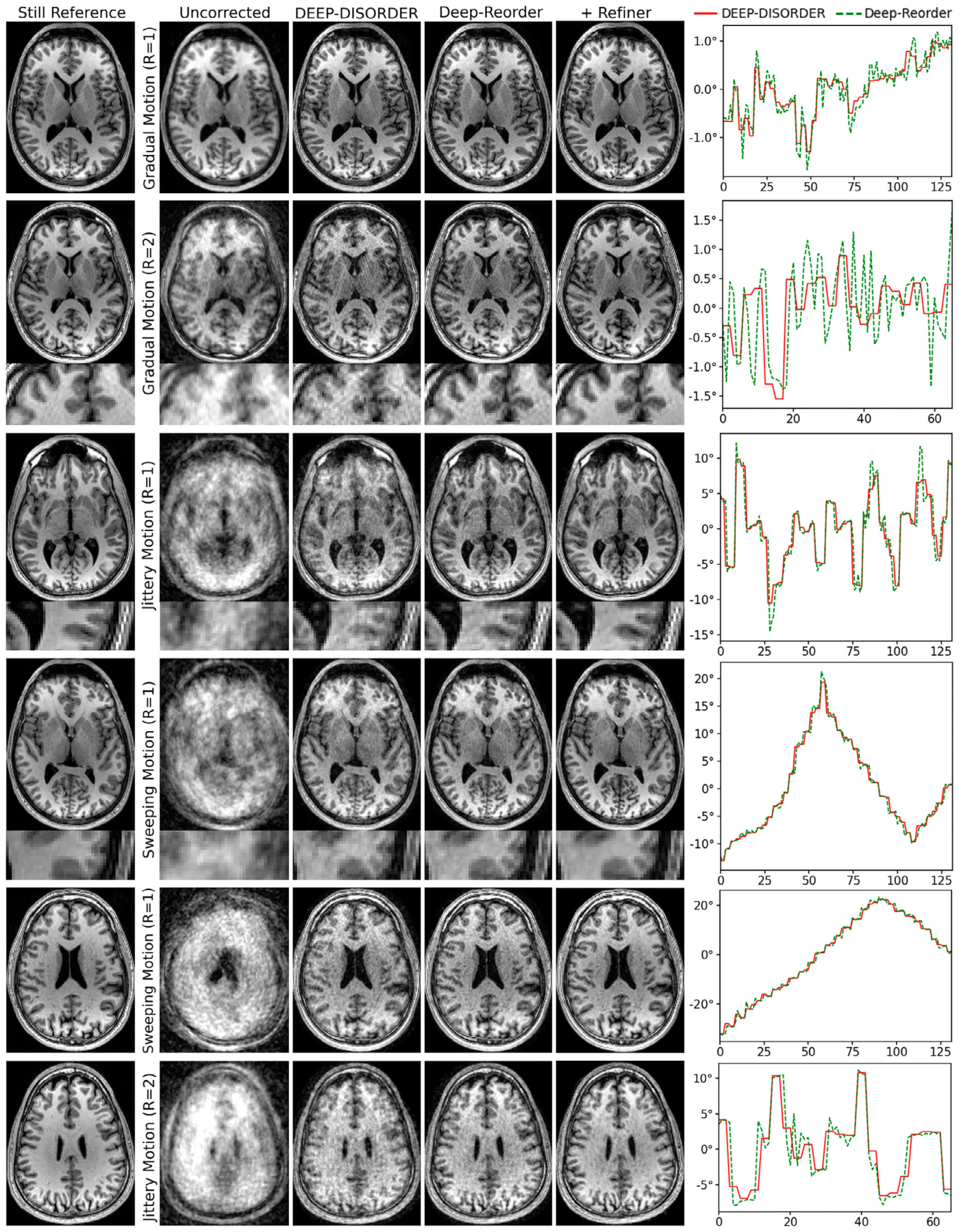
Figure 6. FIGURE 6 | Reconstructions of motion-corrupted 3D MRI scans from volunteers performing intentional motion. From top to bottom, examples with increasingly more severe corruption are shown. The rightmost column of images shows the Deep-Reorder reconstructions after applying the refiner introduced in Section 3.3. The zoomed-in regions exemplify differences that may be difficult to discern at full scale. Finally, the estimated rotational motion about the z-axis (feet-head) is displayed.解説: ボランティアが意図的に頭部を動かしたモーション汚染3D MRIスキャンの再構成例を示しています。未補正、DEEP-DISORDER、Deep-Reorder、そしてさらにリファイナーを適用したDeep-Reorderの画像が比較されています。Deep-Reorderは画像品質を向上させ、右端のプロットではz軸周りの推定回転モーションが表示されています。
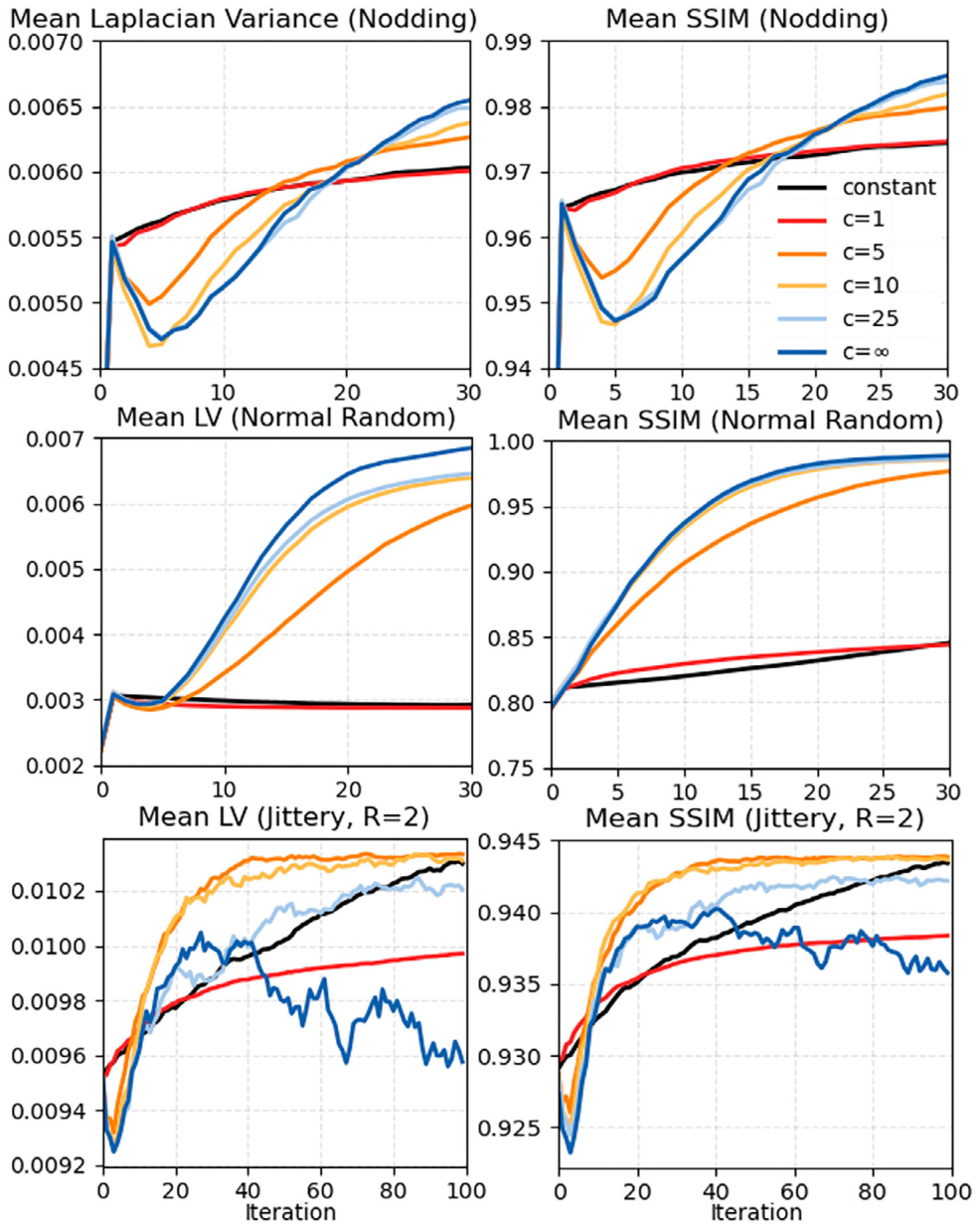
Figure 7. FIGURE 7 | Parameter study investigating the choice of the scale factor 𝑐used in Equation (2), or using a constant limit of Δmax = 0.1. Lower values of 𝑐correspond to a stronger motion update limit, while higher values correspond to a weaker limit, and ∞corresponds to no limit. The top and middle rows present 15 retrospectively corrupted scans while the bottom row presents 3 prospectively corrupted scans.解説: 最大モーション更新関数で使用されるスケール因子cの選択に関するパラメータ研究を示しています。cの値が低いほど強いモーション更新制限を意味し、高いほど弱い制限を意味します。レトロスペクティブデータとプロスペクティブデータにおける、様々なc値でのラプラシアン分散とSSIMの推移が比較されています。
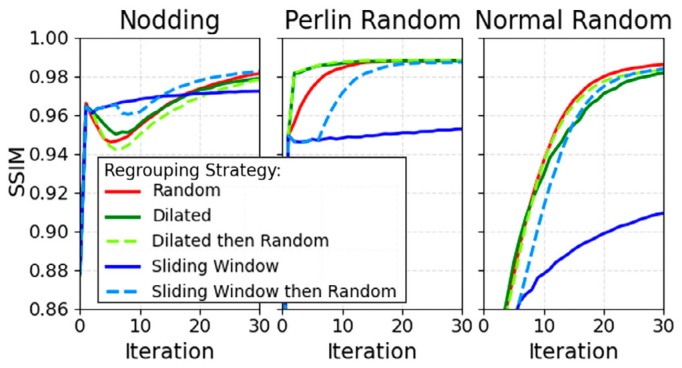
Figure 8. FIGURE 8 | Mean SSIM of alternative regrouping strategies for dif- ferent motion patterns. The dashed blue line represents sliding window switched to random regrouping after five iterations, while the dashed green line represents dilated switched to random regrouping after the sec- ond iteration.解説: 異なるモーションパターンにおける代替再編成戦略の平均SSIMの収束を比較しています。点線の青線は5回の反復後にランダム再編成に切り替わるスライディングウィンドウ、点線の緑線は2回目の反復後にランダム再編成に切り替わるダイレーテッド戦略を示しています。


コメントを残す