どうも、Beyond the Pixelです。心エコー図は心臓診断において中心的な役割を果たす検査であり、その臨床的需要の増加と機械学習の進歩は、自動分析のためのAI開発を加速させています。しかし、これらのAIシステムが重要な意思決定に影響を与える可能性があるため、臨床現場での信頼と説明責任のためには、モデルの解釈可能性が不可欠です。本記事では、この重要なテーマに焦点を当てた包括的なスコーピングレビュー論文の内容に基づき、心エコーAIにおける解釈可能なアプローチの現状、課題、そして今後の展望を詳しく見ていきます。
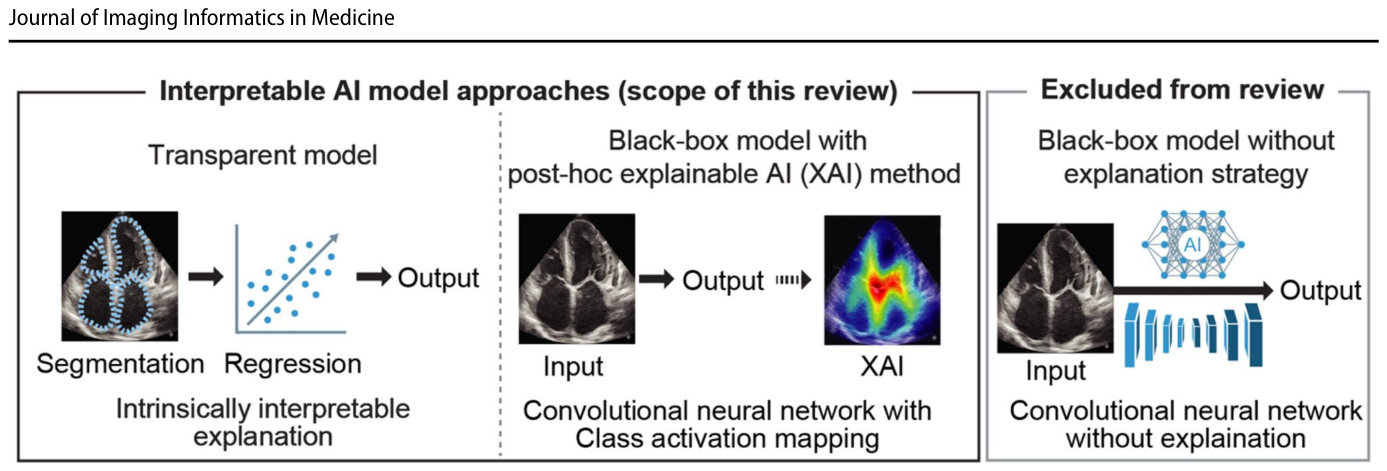
Figure 2. Fig. 2 Conceptual relationship of interpretable AI model approaches. AI models are classified as transparent models, such as segmentation with regression or opaque (black-box) models, such as convolutional neural networks (CNNs). Interpretable AI model approaches, which represent the scope of this review, include both intrinsically inter- pretable explanations and the use of post hoc explainable AI (XAI) methods for black-box models. Studies using black-box models with-解説: 解釈可能なAIモデルアプローチの概念的な関係性を示しており、透明なモデルと、ポストホック説明可能なAI(XAI)を用いるブラックボックスモデルに分類されるAIモデルを図解しています。レビューの対象範囲と、レビューから除外された説明戦略を持たないブラックボックスモデルも示されています。
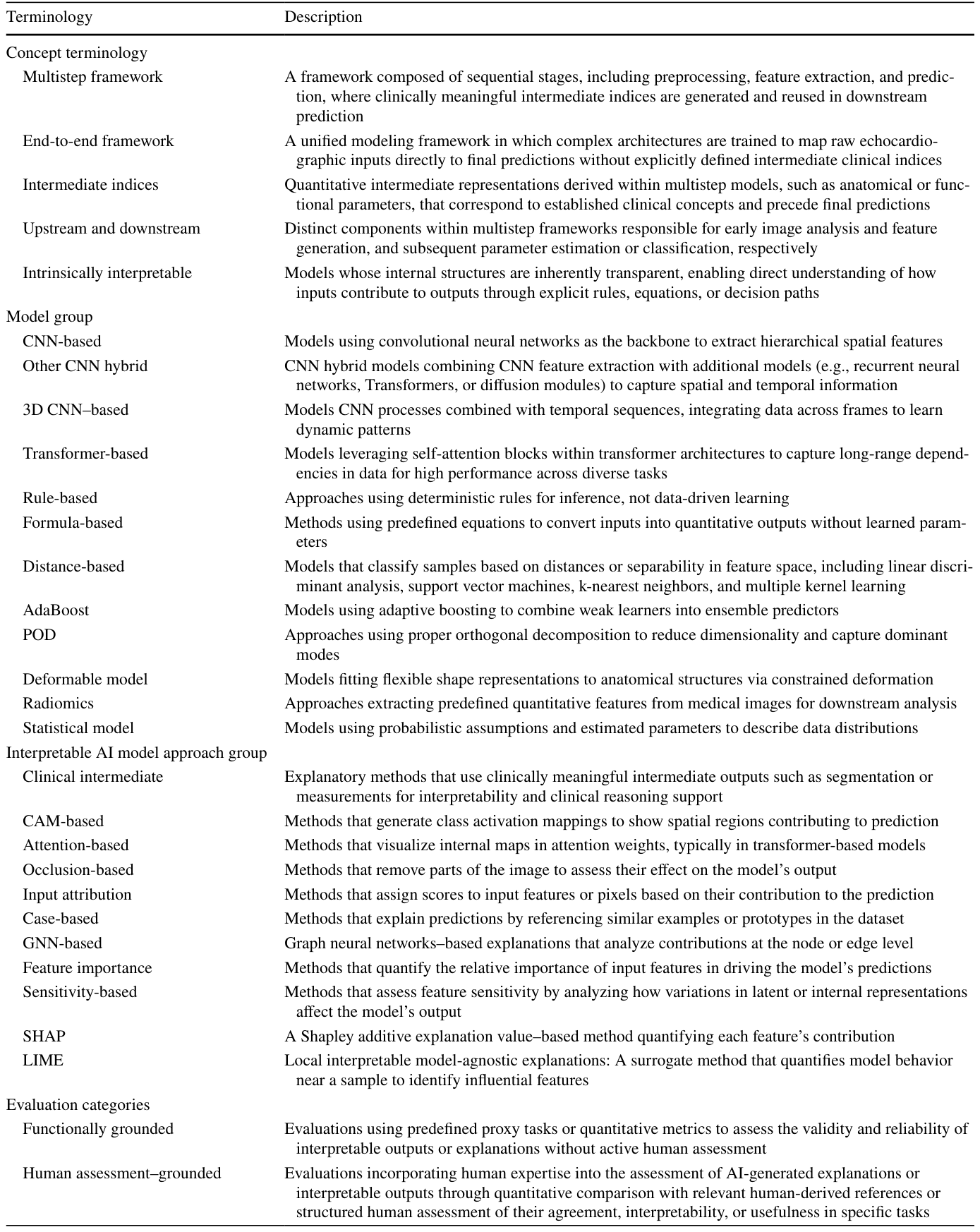
Table 1. Table 1 Glossary of terminology and category definitions used in this review. Frequently used terms are defined to support readability through- out the manuscript. Boldface indicates the letters used to form each abbreviation解説: 本レビューで使用される用語とカテゴリ定義の用語集です。頻繁に使用される用語が、論文全体での読みやすさをサポートするために定義されています。
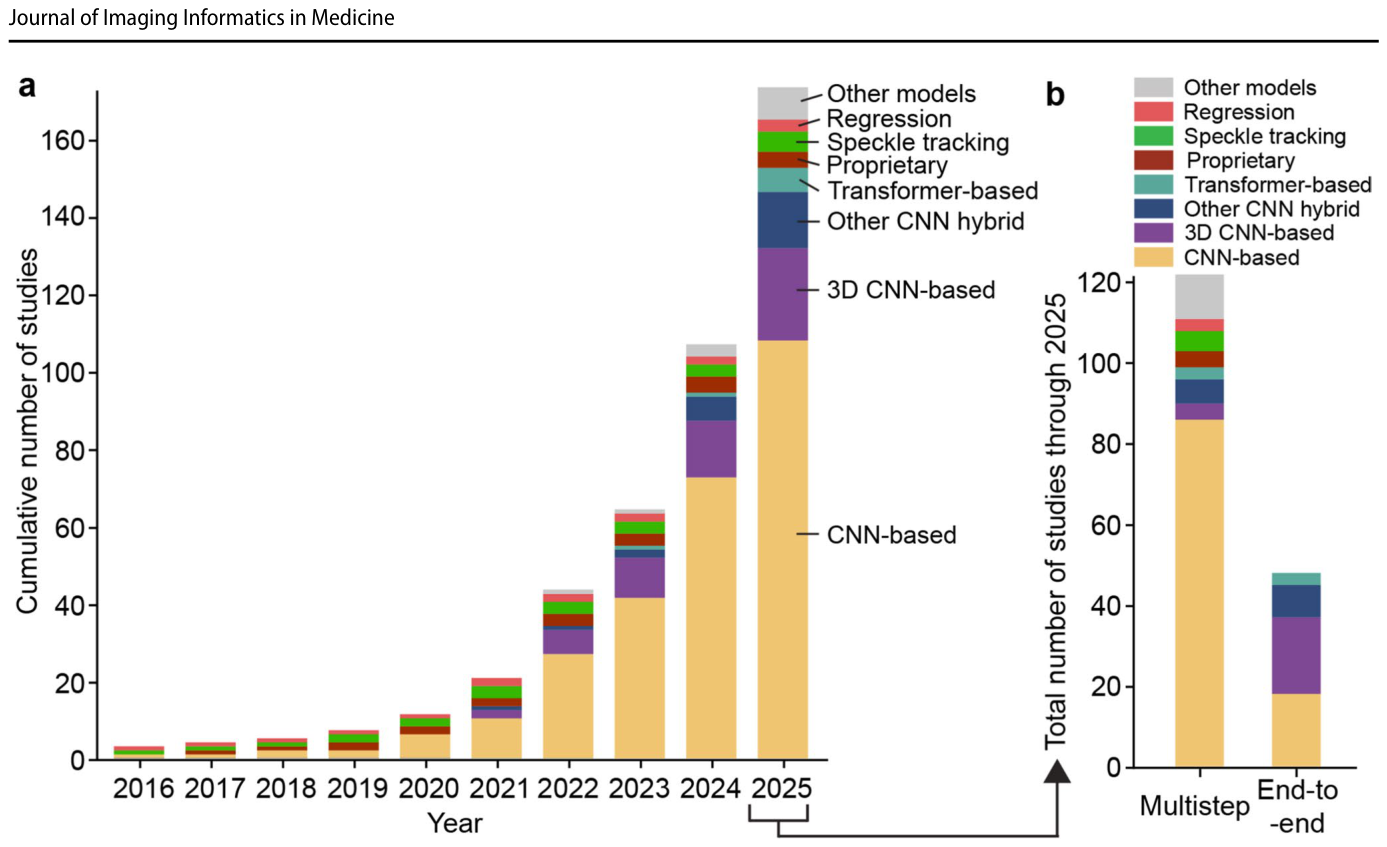
Figure 4. Fig. 4 Temporal trends in AI model types across echocardiographic AI studies with interpretable AI model approaches. (a) Cumulative number of studies from 2016 to 2025, categorized by eight model groups. The number of studies increased over the past decade, with the cumulative number approximately doubling in 2022 compared with the total through 2021. Since then, conventional approaches, such as speckle tracking or regression, have not shown substantial growth, whereas CNN-based models have become dominant. More advanced architectures, including 3D CNN–based and transformer- based models, have subsequently emerged, indicating a shift toward解説: 解釈可能なAIモデルアプローチを用いた心エコーAI研究におけるAIモデルタイプの経時的傾向を示しています。グラフ(a)は2016年から2025年までの研究の累積数を、グラフ(b)はマルチステップとエンドツーエンドの各フレームワークにおけるモデルタイプの総数を示しています。
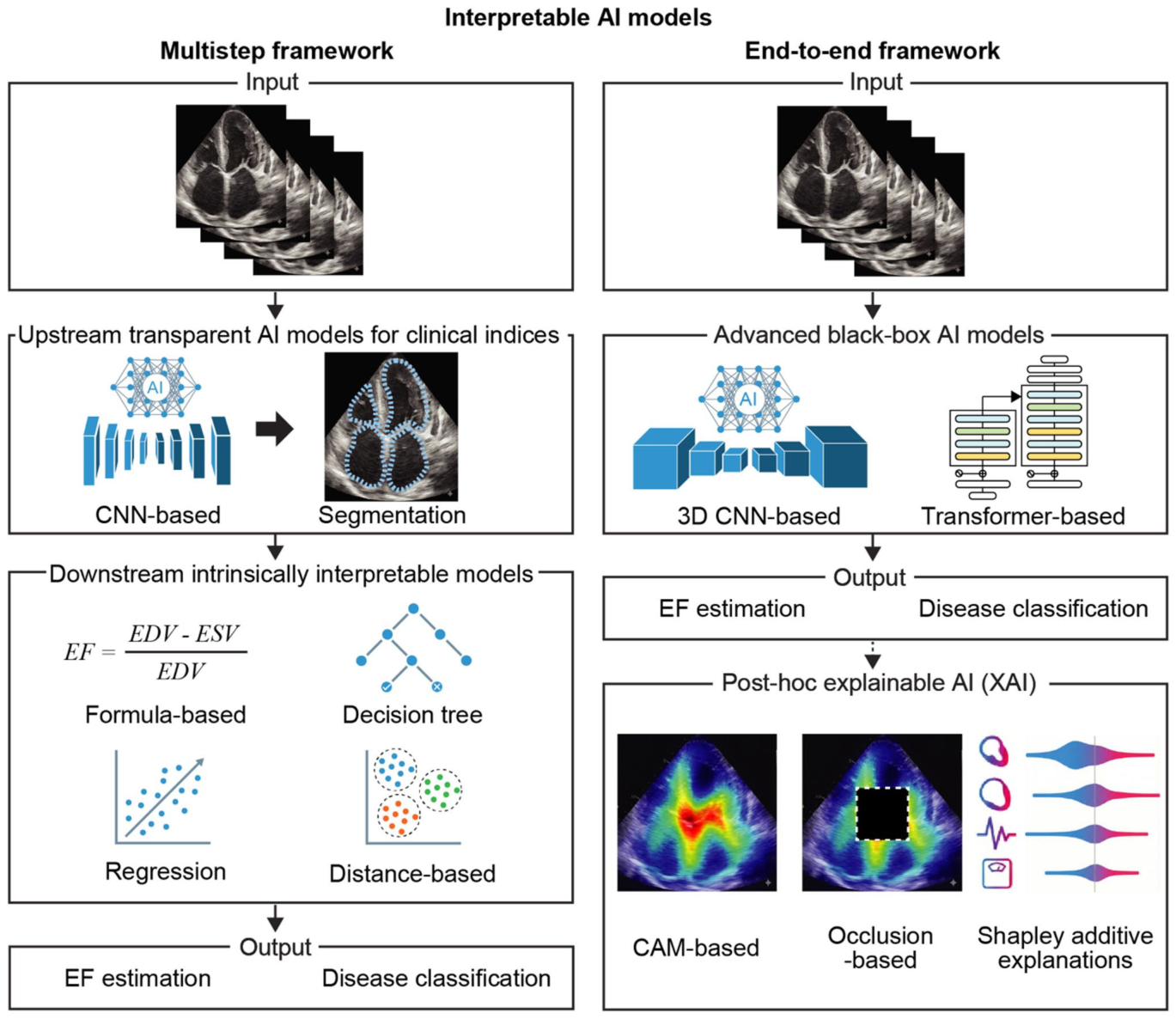
Figure 3. Fig. 3 Overview of multistep and end-to-end frameworks. Labels indicate the coding categories used in this review, and schematic icons show representative examples within each category; for exam- ple, the icon labeled CAM-based represents a class activation map- ping-type visualization. Within each framework, specific AI model types are implemented as structural components of the overall ana- lytical design. In the multistep framework, upstream models derive clinically meaningful intermediate representations from inputs (e.g., segmentation). These representations are then used by downstream intrinsically interpretable models, such as formula-based, regression-解説: マルチステップフレームワークとエンドツーエンドフレームワークの概要を示しています。図中のラベルは、本レビューで使用されたコーディングカテゴリを表しており、各フレームワークにおける入力、モデルの種類、説明手法、および出力の関係性が示されています。
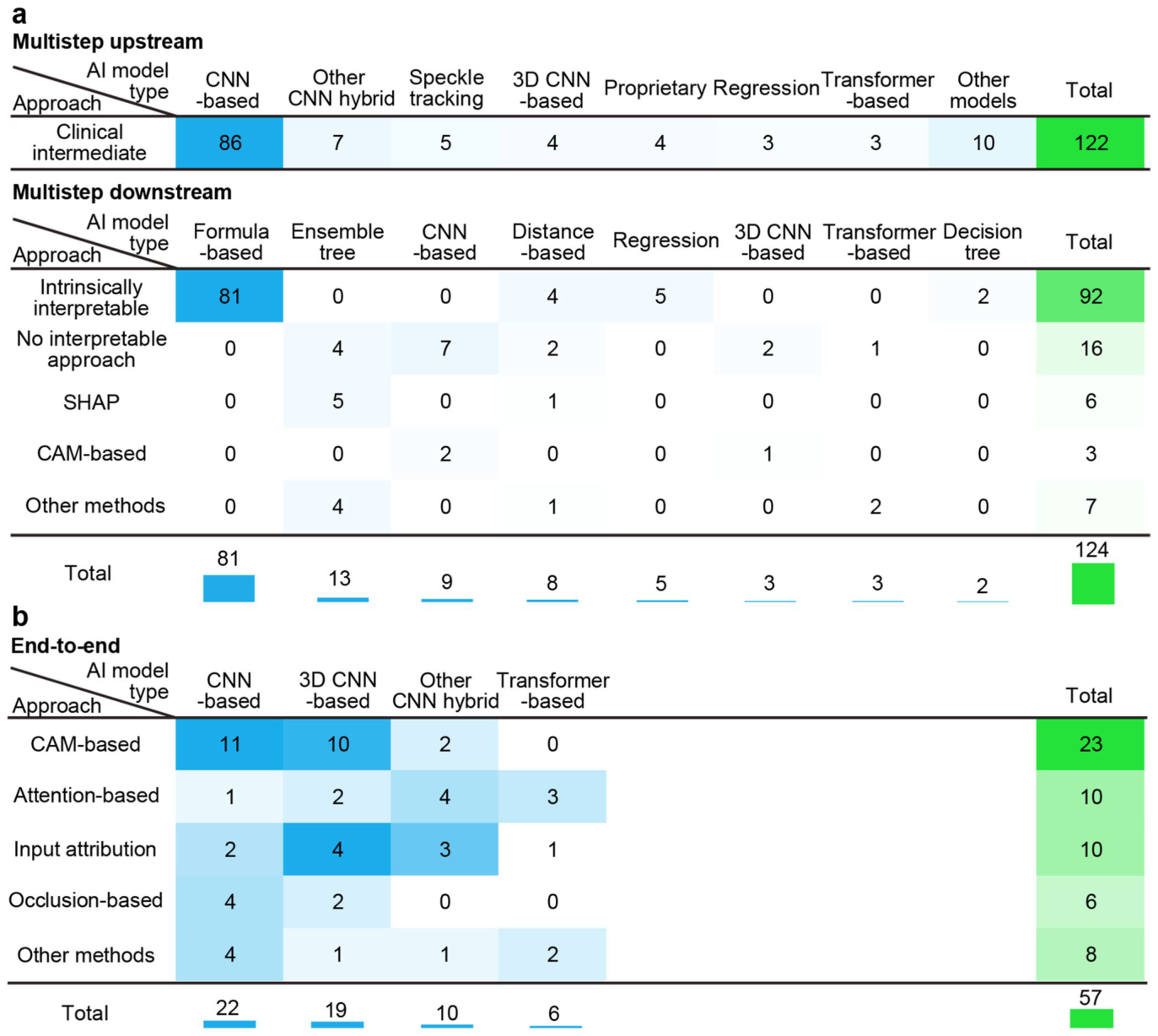
Figure 5. Fig. 5 Combinations of model types and interpretable AI model approaches. Heatmaps visualize frequently used combinations and underexplored areas, showing multistep upstream and downstream model-approach instances with their corresponding interpretable AI model approaches (a) and end-to-end model-approach instances with post hoc XAI methods (b). Counts represent model-approach instances, not unique studies. a In multistep upstream, CNN-based models dominate, reflecting their widespread use for segmenta- tion tasks and their emergence as a standard approach. Conven- tional methods, including speckle tracking and regression, are also observed, with limited adoption of more advanced architectures. In multistep downstream models, clinically interpretable indices derived from upstream segmentation are typically used as inputs to intrinsically interpretable models, such as formula-based approaches, to generate outputs aligned with clinical definitions (e.g., EF estima- tion and disease grading). In some model-approach instances, these features are instead used as inputs to more complex models, such as ensemble trees or CNN-based models. A total of 17 instances were labeled as “No interpretable approach.” This label was used when解説: モデルタイプと解釈可能なAIモデルアプローチの組み合わせを示しています。ヒートマップにより、マルチステップフレームワーク(アップストリームおよびダウンストリーム)とエンドツーエンドフレームワークの両方で、頻繁に使用される組み合わせが視覚化されています。
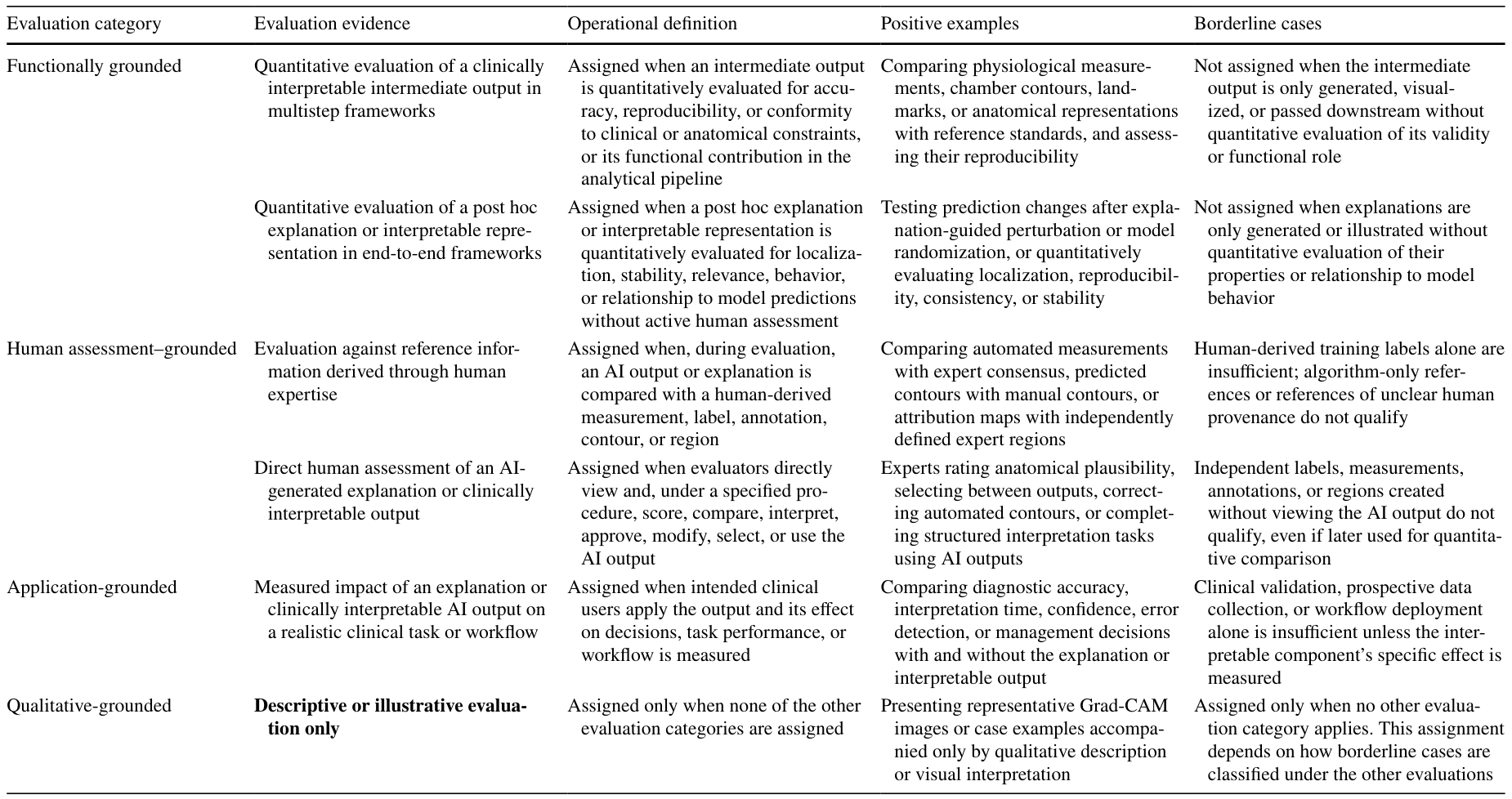
Table 2. Table 2 Operational decision table for coding evaluation categories. More than one evaluation category could be assigned. Qualitative-grounded evaluation was assigned only when none of the解説: 評価カテゴリをコーディングするための操作的決定表です。複数の評価カテゴリが割り当てられる可能性があり、定性的評価は他のどのカテゴリも当てはまらない場合にのみ割り当てられました。
マルチステップ研究では、定量的に定義された臨床指標の報告がより頻繁に行われ、いくつかの研究では前向きなアプリケーションレベルでの実装が示されました。対照的に、エンドツーエンドの研究は、マルチステップのアップストリーム研究と比較して、定性的評価に依存する傾向がより顕著でした(23/57, 40.4% vs 2/122, 1.6%)。これは、エンドツーエンドモデルが臨床現場での導入を支持するためには、より意識的なポストホック説明方法と、より強力な定量的評価が必要であることを示唆しています。(図5)これらの評価を通じて、AIシステムが臨床的に信頼できるものであることを確立するための包括的なフレームワークが不可欠となります。
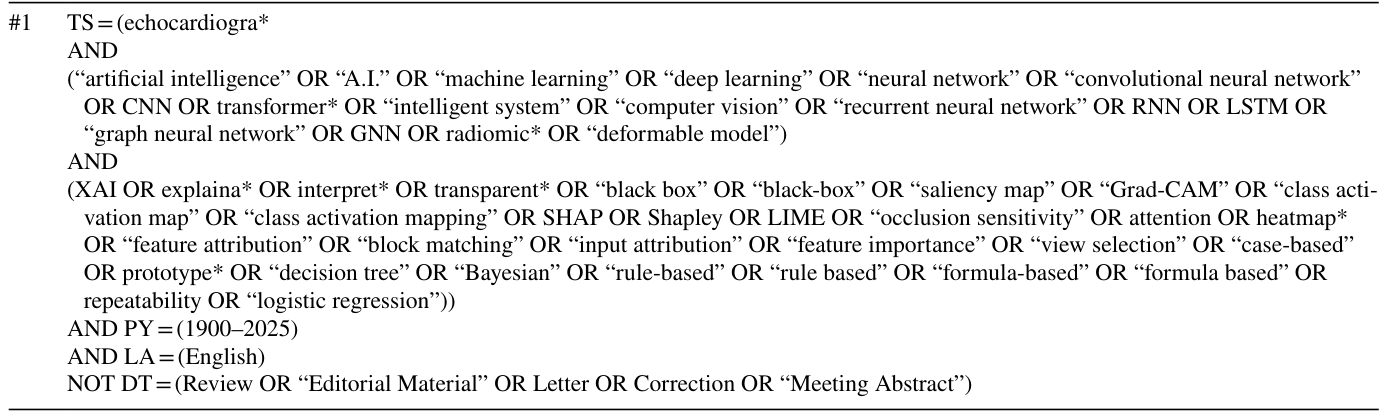
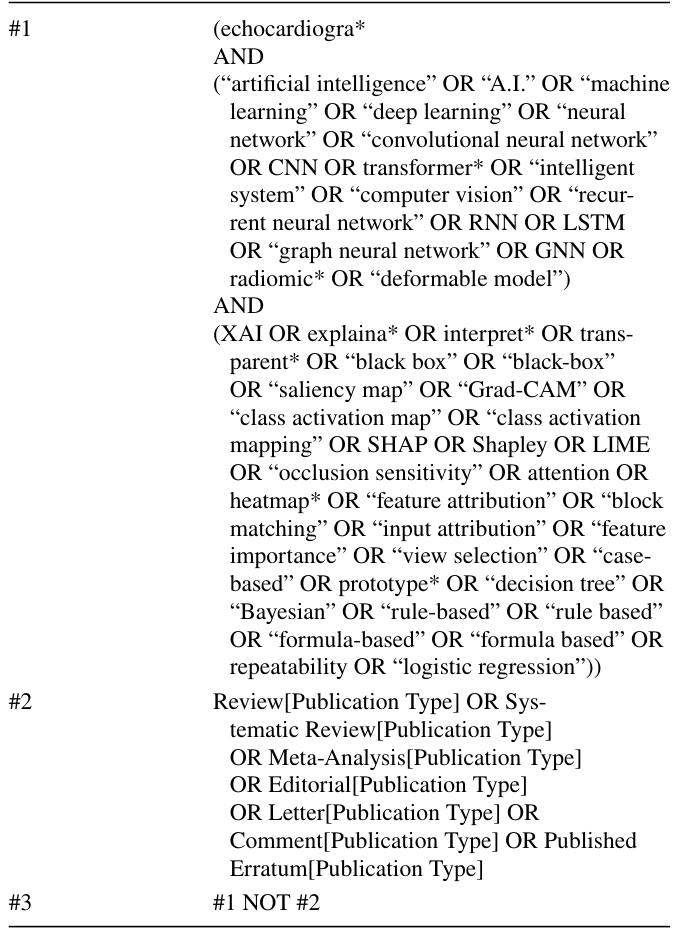
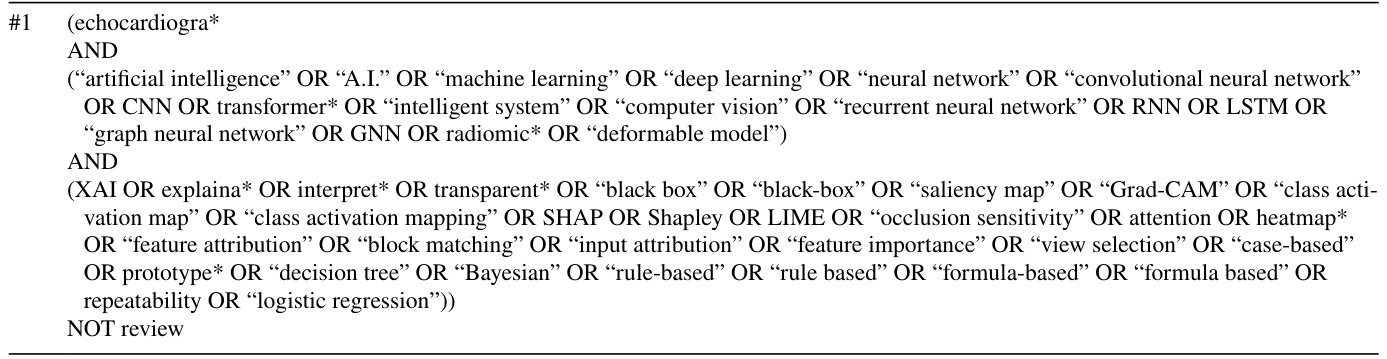
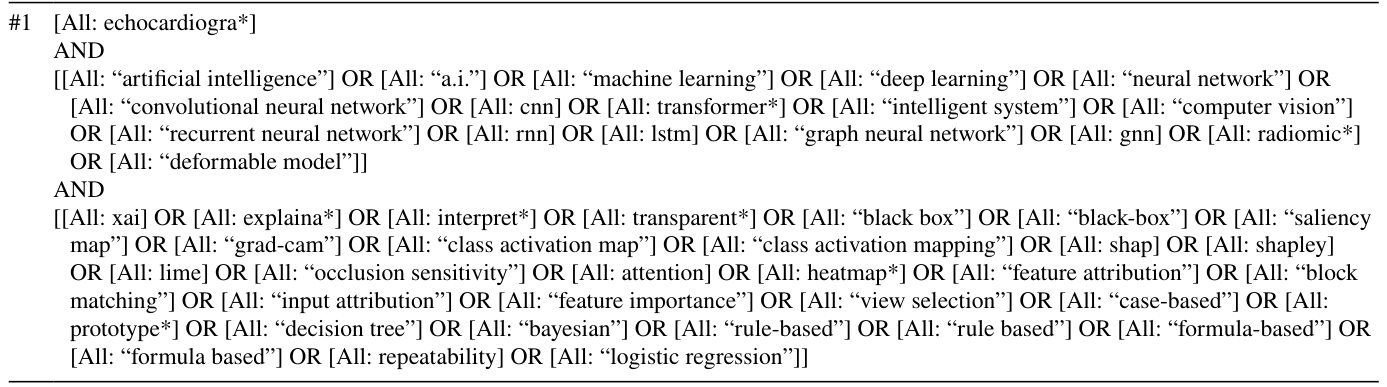
Web of Science、PubMed、IEEE Xplore、ACM Digital Libraryの4つの電子データベースで構造化された文献検索が行われ、心エコー図におけるAI研究で解釈可能なAIモデルアプローチを採用している研究を特定しました。検索クエリは「echocardiogra*」とAI/機械学習、そしてXAI/解釈可能性に関連する多様な専門用語を組み合わせることで設計されました。
Table 5. Table 5 Search conditions on Web of Science解説: Web of Scienceにおける検索条件が示されています。AIと心エコー図に関する解釈可能性のある研究を特定するために使用された具体的なクエリとフィルターが含まれています。Table 6. Table 6 Search conditions on PubMed with database availability through 2025解説: PubMedにおける検索条件が示されています。2025年までのデータベース利用可能性が考慮されており、特定の検索クエリと除外条件が詳細に記載されています。Table 7. Table 7 Search conditions on IEEE Xplore with database availability through 2025解説: IEEE Xploreにおける検索条件が示されています。2025年までのデータベース利用可能性が考慮されており、使用された検索クエリとレビュー記事の除外条件が記載されています。Table 8. Table 8 Search conditions on ACM Digital Library with database availability through 2025解説: ACM Digital Libraryにおける検索条件が示されています。AI、機械学習、および解釈可能性に関連する多様なキーワードを組み合わせた検索クエリが含まれています。
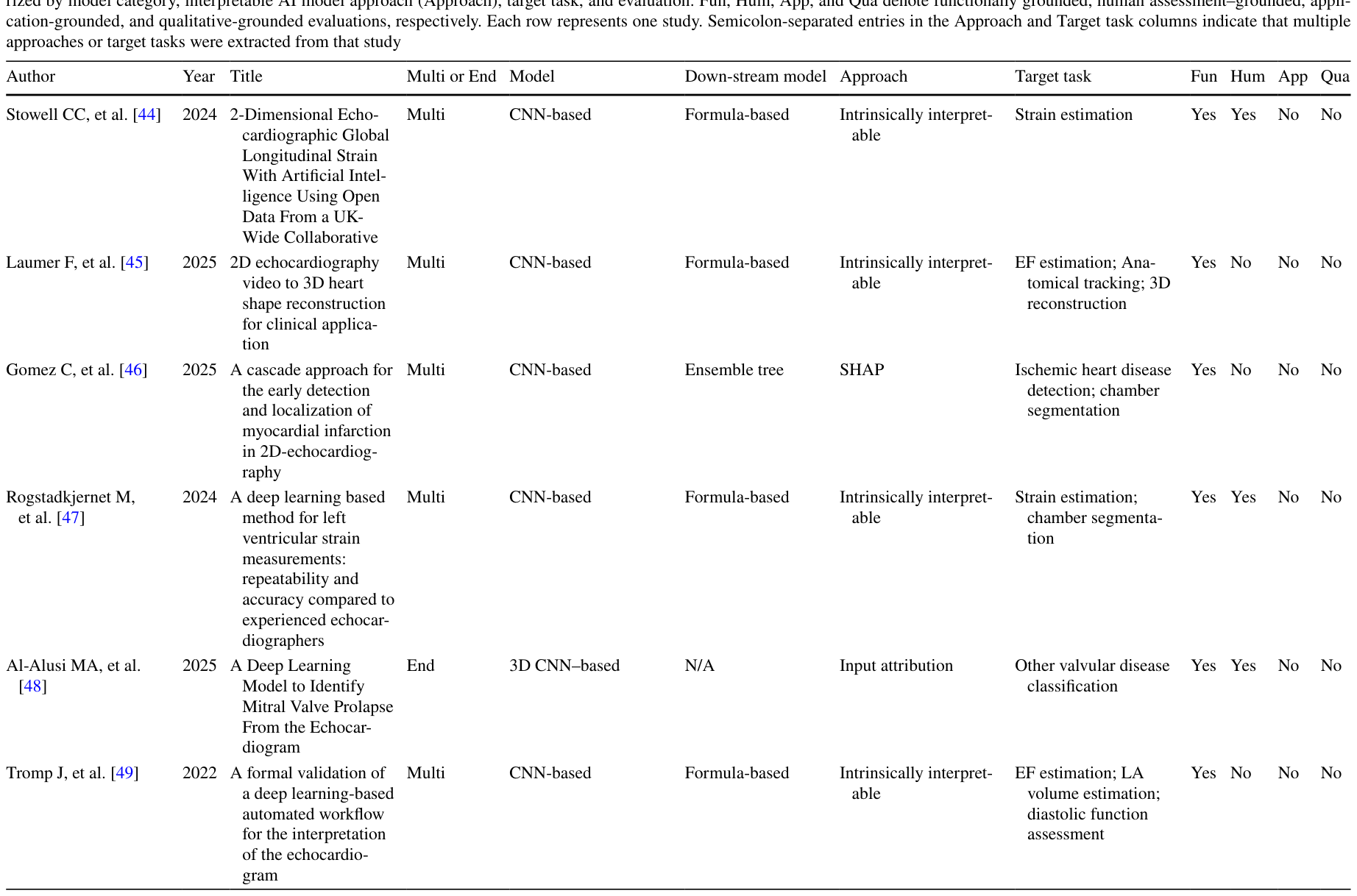
Table 4. Table 4 Summary of echocardiography AI studies included after final eligibility screening. Studies are organized by multistep or end-to-end framework, labeled as Multi and End, and summa-解説: 最終的な適格性スクリーニング後に含まれた心エコーAI研究の概要です。研究はマルチステップまたはエンドツーエンドのフレームワークによって分類され、モデルカテゴリ、解釈可能なAIモデルアプローチ(アプローチ)、対象タスク、および評価によって要約されています。

コメントを残す