メジャーな手術中における心拍出量のリアルタイムな評価は、対象者の組織への適切な血流維持に不可欠ですが、これまでの高度なモニタリング技術は限られたハイリスクな症例にしか適用されていませんでした。多くの対象者が、手術中に低心拍出量となるリスクを見過ごされる可能性がありました。この課題に対し、日常的に利用可能なパラメータを用いて、低心拍出量を持続的かつリアルタイムでスクリーニングするための簡便なツール、「Low Cardiac Index (LCI) スコア」が開発されました。
どうも、Beyond the Pixelです。メジャーな手術では、対象者の体中の組織へ十分な血液が送られているか(これを「組織灌流」と呼びます)を確保するために、適切な心臓の拍出量(心拍出量)を維持することが極めて重要です。心拍出量が低下すると、組織への血流が不足し、臓器機能の障害や死亡リスクの増加につながる可能性があります。しかし、これまで心拍出量を直接、継続的に測定するには、特殊な機器と専門知識が必要であり、使用できるのはごく一部のハイリスクな対象者に限られていました。その結果、多くの手術対象者は、リアルタイムで心拍出量の状態を把握できず、低心拍出量の状態を見逃してしまう可能性がありました。本研究は、この課題を解決するため、日常的に得られるデータを使って、手術中に低心拍出量を継続的にスクリーニングできる「Low Cardiac Index (LCI) スコア」を開発し、その有用性を内部検証することを目的としました。このスコアは、動脈カテーテルを挿入しているものの、高度な心拍出量モニタリングを受けていない機械換気中の対象者において、低心拍出量を「除外する」ツールとして設計されています。
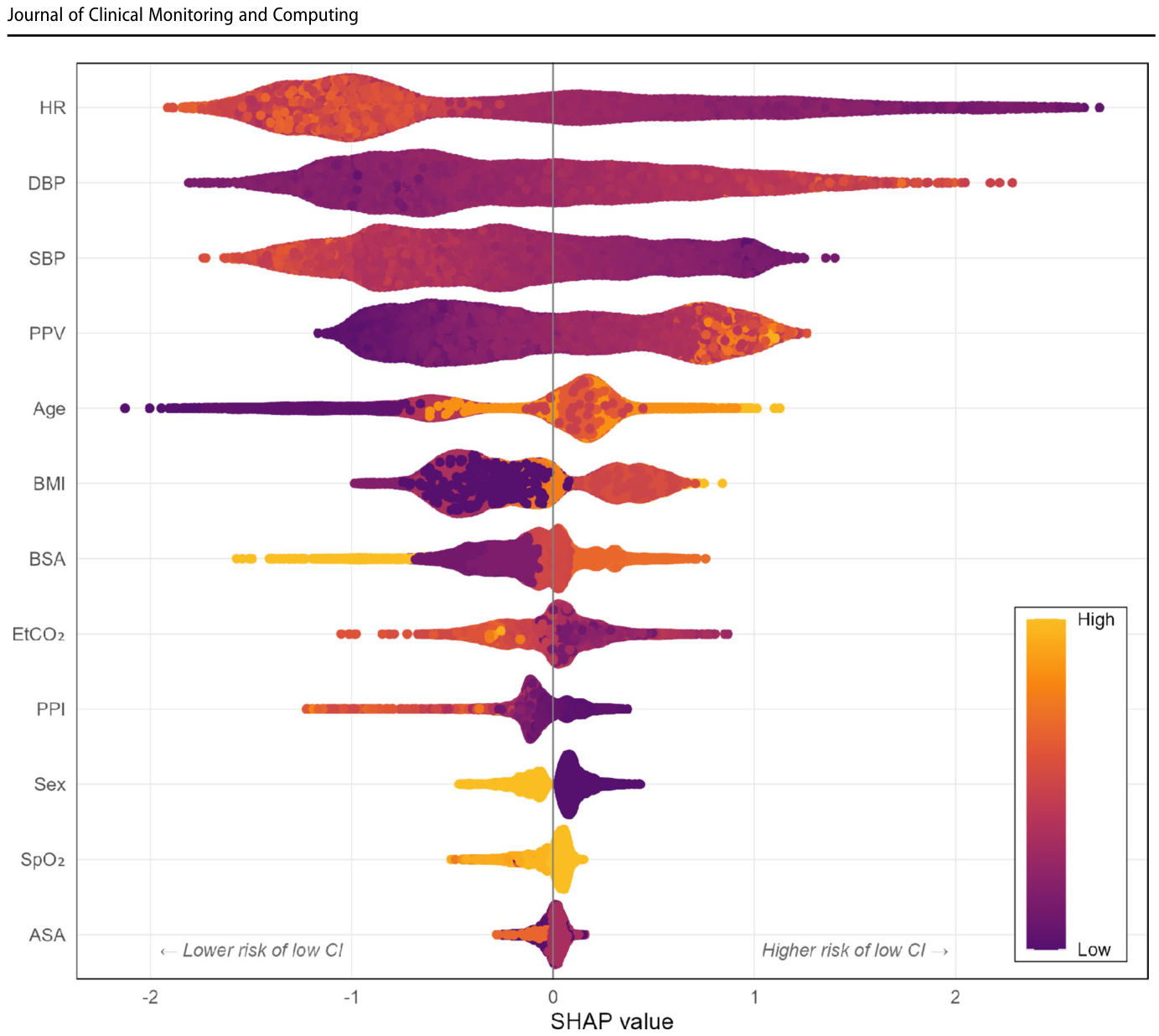
Figure 2. Fig. 2 SHAP feature importance for the 12 candidate variables. Each dot represents a single timepoint; horizontal position indicates the con tribution to the predicted risk of low cardiac index, and colour repre sents the original feature value (yellow = high, purple = low). Features are ordered by mean absolute SHAP value. The top five features (HR, DBP, PPV, SBP, Age) were selected for final model development. For解説: この図は、12の候補変数それぞれが低心拍出量リスクの予測にどの程度寄与しているか(SHAP値)を示しています。各点は個々の時系列データポイントを表し、横軸は予測リスクへの寄与度、色は元の特徴量値(黄色が高い、紫が低い)を表します。心拍数(HR)、拡張期血圧(DBP)、脈圧変動(PPV)、収縮期血圧(SBP)、年齢(Age)が平均絶対SHAP値で上位5つを占め、最終的なモデル開発に選択されました。
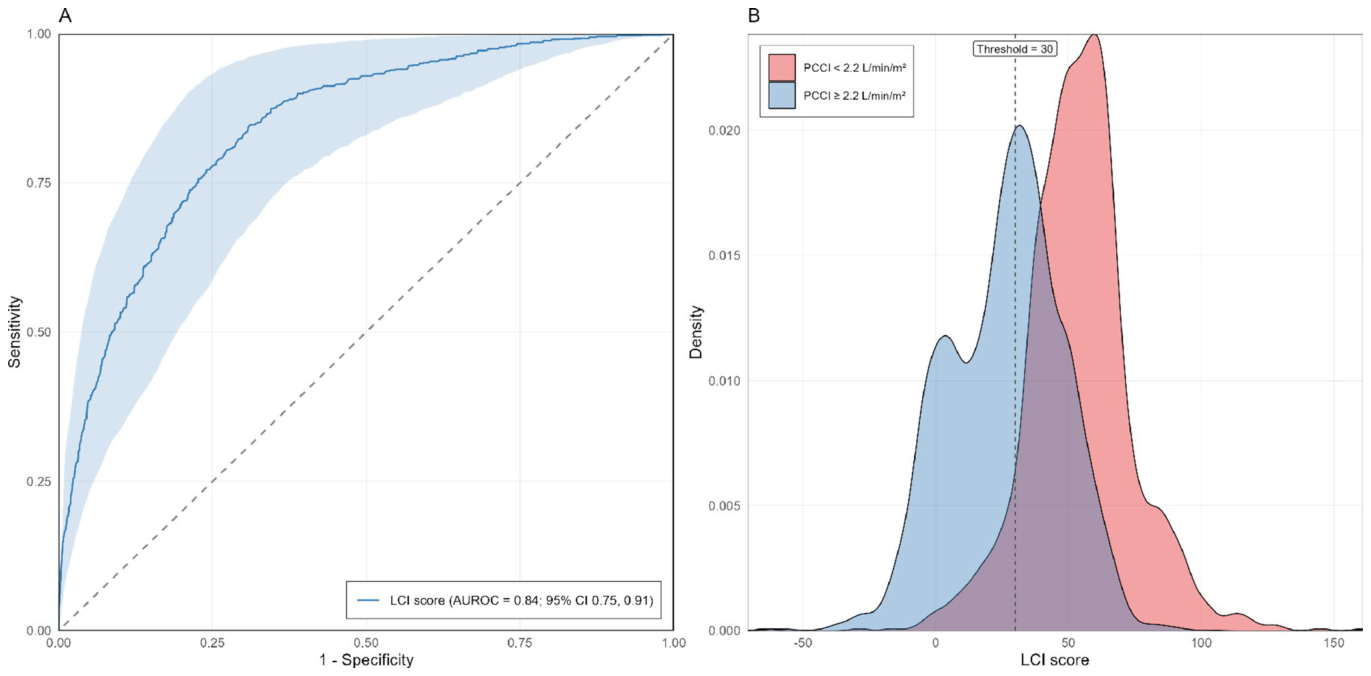
Figure 3. Fig. 3 Discriminative performance and score distribution of the LCI score. (A) Receiver operating characteristic curve evaluated on the test set (28 patients, 8,418 timepoints); dashed diagonal line represents chance-level discrimination. The shaded band represents the pointwise 95% confidence interval for sensitivity, derived from patient-level cluster bootstrap resampling (1,000 iterations). (B) Density distribu解説: この図は、LCIスコアの判別性能とスコア分布を示しています。(A)はテストセットで評価された受信者操作特性(ROC)曲線で、LCIスコアのAUROCは0.84(95% CI 0.75, 0.91)でした。(B)は、測定されたPCCI(低心拍出量とそうでない場合)によって層別化されたテストセットにおけるLCIスコア値の密度分布を示しており、スクリーニングしきい値の30が破線で示されています。
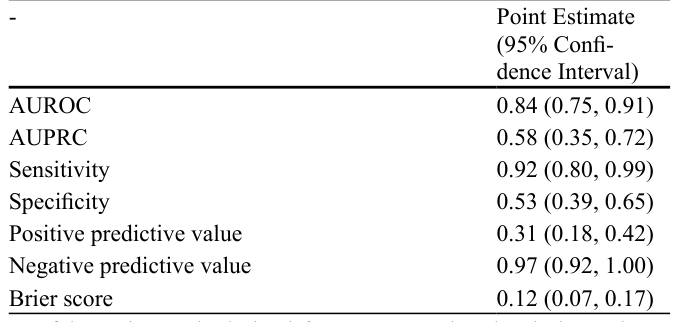
Table 2. Table 2 Performance of the LCI Score on the Test Set – Point Estimate (95% Confi dence Interval) AUROC 0.84 (0.75, 0.91) AUPRC 0.58 (0.35, 0.72) Sensitivity 0.92 (0.80, 0.99) Specificity 0.53 (0.39, 0.65) Positive predictive value 0.31 (0.18, 0.42) Negative predictive value 0.97 (0.92, 1.00) Brier score 0.12 (0.07, 0.17) Confidence intervals derived from 1,000 patient-level cluster boot strap resamples of the test set (28 patients, 8,418 timepoints). The LCI score threshold (≥ 30) was derived from the training set to achieve sensitivity ≥ 0.90, then applied to the test set without modification. AUROC, area under the receiver operating characteristic curve; AUPRC, area under the precision-recall curve; LCI, low cardiac index解説: この表は、テストセットにおけるLCIスコアの性能評価指標をまとめたものです。AUROCは0.84、AUPRCは0.58でした。スクリーニングしきい値30を用いると、感度0.92、特異度0.53、陽性的中率0.31、陰性的中率0.97を達成しました。Brierスコアは0.12でした。
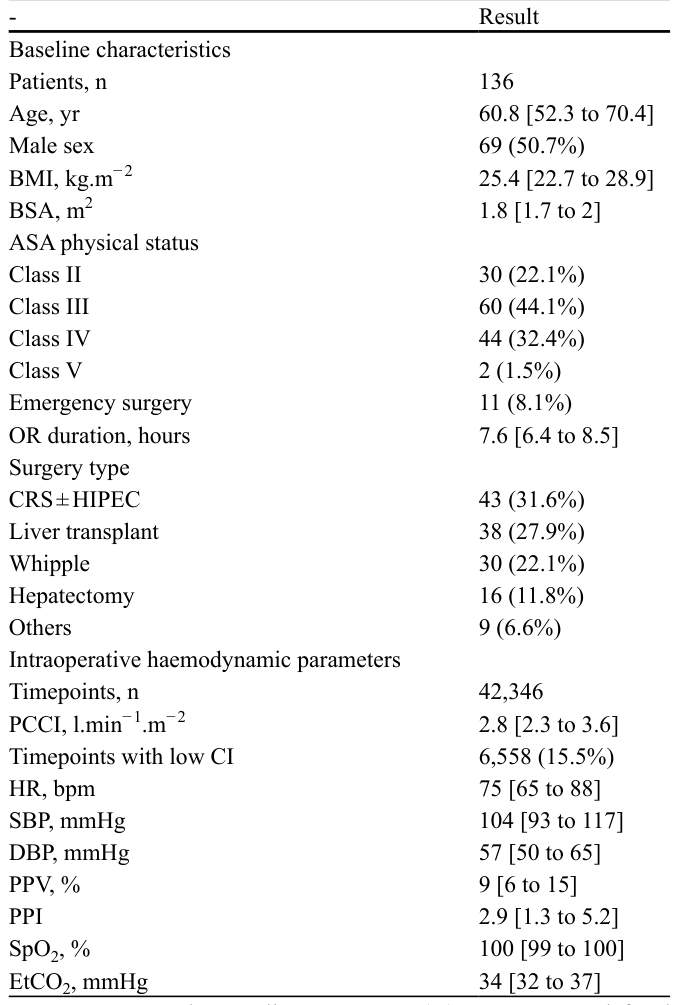
。対象者のベースライン特性と術中の血行動態パラメータの詳細は、
Table 1. Table 1 Baseline Characteristics and Intraoperative Haemodynamic Parameters – Result Baseline characteristics Patients, n 136 Age, yr 60.8 [52.3 to 70.4] Male sex 69 (50.7%) BMI, kg.m− 2 25.4 [22.7 to 28.9] BSA, m2 1.8 [1.7 to 2] ASA physical status Class II 30 (22.1%) Class III 60 (44.1%) Class IV 44 (32.4%) Class V 2 (1.5%) Emergency surgery 11 (8.1%) OR duration, hours 7.6 [6.4 to 8.5] Surgery type CRS ± HIPEC 43 (31.6%) Liver transplant 38 (27.9%) Whipple 30 (22.1%) Hepatectomy 16 (11.8%) Others 9 (6.6%) Intraoperative haemodynamic parameters Timepoints, n 42,346 PCCI, l.min− 1.m− 2 2.8 [2.3 to 3.6] Timepoints with low CI 6,558 (15.5%) HR, bpm 75 [65 to 88] SBP, mmHg 104 [93 to 117] DBP, mmHg 57 [50 to 65] PPV, % 9 [6 to 15] PPI 2.9 [1.3 to 5.2] SpO2, % 100 [99 to 100] EtCO2, mmHg 34 [32 to 37] Data are presented as median [IQR] or n (%). Low CI was defined as PCCI < 2.2 l.min− 1.m− 2. Other surgeries include oesophagectomy, colectomy, gastrectomy, anterior resection, kidney transplant, and combined pancreas-kidney transplant. ASA, American Society of Anesthesiologists; BMI, body mass index; BSA, body surface area; CI, cardiac index; CRS, cytoreductive surgery; DBP, diastolic blood pressure; EtCO2, end-tidal carbon dioxide; HIPEC, hyperthermic intraperitoneal chemotherapy; HR, heart rate; IQR, interquartile range; OR, operating room; PCCI, pulse contour cardiac index; PPI, peripheral perfusion index; PPV, pulse pressure variation; SBP, sys tolic blood pressure; SpO2, peripheral oxygen saturation解説: この表は、研究対象者のベースライン特性と術中の血行動態パラメータの要約です。136名の対象者について、年齢中央値は60.8歳、男性が50.7%でした。総計42,346の時系列データポイントのうち、低心拍出量は6,558ポイント(15.5%)で観察されました。心拍数、収縮期血圧、拡張期血圧、脈圧変動など、主な血行動態パラメータの中央値も示されています。


コメントを残す